
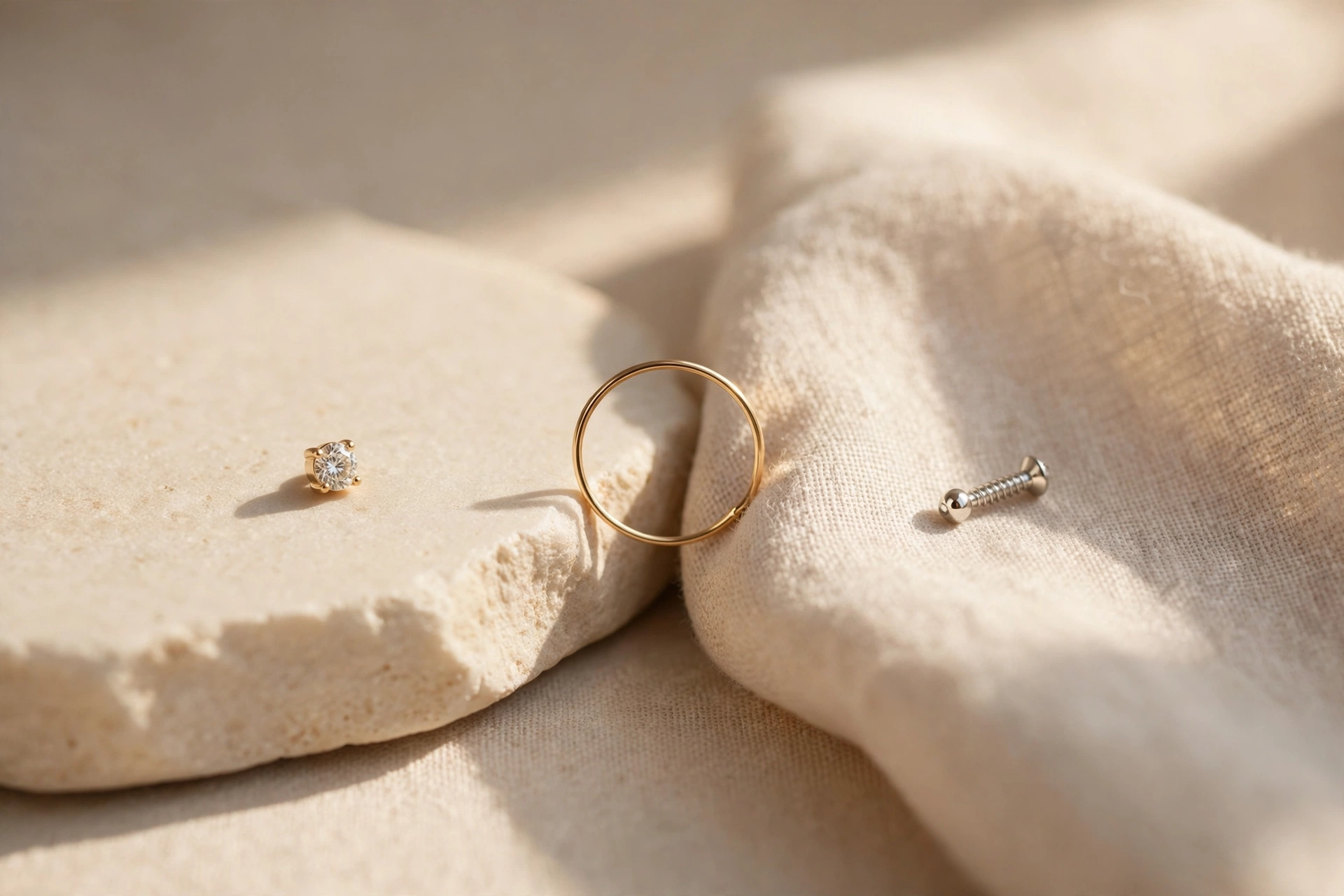
Nose piercing jewellery comes in more shapes, sizes and materials than most people expect. The right piece depends on three things: the style of piercing you have, the material that suits your skin, and the stage of healing your piercing has reached. Get those three right and your jewellery will look good and heal well.
This guide covers the main styles, gauge and sizing, the safest materials, healing times, and how to change your jewellery safely.
The short answer is simple. A small flat back stud in implant grade titanium is the safest choice for a new nostril piercing. Rings and screws suit healed piercings better. Wait until healing is complete before you change jewellery, clean it with saline, and see your piercer if you notice signs of infection.
Studs, Rings and Screws: Which Style Suits You
Most nose jewellery falls into three main styles. Each one looks different, feels different and suits a different stage of healing.
Studs
A stud is the most common choice for a nostril piercing. It has a decorative top on the outside of the nose and a post that passes through the piercing, held in place by a flat back, a ball, or a small bend in the metal.
Flat back studs, also called labret studs, are the best option for a new piercing. The flat disc sits flush against the inside of the nostril, so it does not catch on clothing or towels. Push pin studs use a small pin that slots into a hollow post. They are easy to change once the piercing has healed, and they come in a wide range of tops, from tiny gems to simple balls.
Studs suit most face shapes and most occasions. A small gem stud looks neat for everyday wear. For a subtle look, choose a top between 1.5 mm and 2.5 mm across. For more impact, go a little larger.
Rings
A ring, or hoop, circles through the piercing and sits around the edge of the nostril. Rings give a softer, more relaxed look than studs.
Rings come in several forms. A seamless ring has no visible join. A captive bead ring holds a small bead in place with tension. A clicker ring opens and closes on a hinge, which makes it easy to change once the piercing has healed.
Rings are not the best choice for a fresh piercing. They move more than studs, and that movement can slow healing and irritate the piercing. Most piercers advise waiting until the piercing is fully healed before switching to a ring. A septum piercing is the exception. It is usually pierced with a circular barbell or a clicker ring, because that shape suits the position.
Screws
A nose screw has a straight post with a curved tail that sits inside the nostril. The curve holds the jewellery in place without a separate back, so nose screws feel secure and comfortable to wear.
The curved tail can make a nose screw harder to put in and take out than a stud. It takes a little practice to guide the curve through the piercing. For that reason, nose screws suit healed piercings better than fresh ones. They are a good option if you have lost studs in the past, because the screw shape is less likely to fall out.
An L shaped stud works in a similar way. The post bends at a right angle inside the nostril. It is easier to insert than a full screw, but it can still catch on fabric. Your piercer can help you pick the right style. The shape of your nostril, the position of the piercing and the stage of healing all matter.
Gauge and Sizing in Plain Terms
Gauge means the thickness of the post or ring. Length or diameter means how long the post is or how wide the ring is. Getting these right matters. Jewellery that is too thin can cut into the piercing. Jewellery that is too short can press into the skin. Jewellery that is too long can catch and move around.
Most nostril piercings in the UK are pierced at 18 gauge or 20 gauge. An 18 gauge post is about 1 mm thick. A 20 gauge post is about 0.8 mm thick. The lower the gauge number, the thicker the jewellery. Septum piercings are usually pierced at 16 gauge, which is about 1.2 mm thick.
Post length matters just as much as thickness. A fresh piercing needs a slightly longer post to allow for swelling. Once the swelling has settled, your piercer can fit a shorter post that sits neatly. A post that is too long will move and catch. A post that is too short will press into the skin.
Ring diameter is the width across the inside of the ring. For a nostril ring, it needs to fit the distance from the piercing hole to the edge of the nostril. Too small and the ring will pull. Too large and it will hang loose and catch on things. Most people find a diameter between 7 mm and 9 mm comfortable, but the right size depends on your nose.
| Piercing | Common gauge | Typical post or ring size |
|---|---|---|
| Nostril | 18 or 20 gauge | 6 mm to 7 mm post, 7 mm to 9 mm ring |
| Septum | 16 gauge | 8 mm to 10 mm circular barbell or clicker |
| High nostril | 18 gauge | 6 mm to 7 mm post |
Never force jewellery into a piercing. If a piece does not slide in easily, the size is wrong or the piercing is not ready. Ask your piercer to check the fit. They can measure your piercing and find the right gauge, length and diameter.
Safe Materials for Nose Jewellery
The material of your nose jewellery matters more than the style. Your piercing is an open wound while it heals, and some metals can irritate it or cause a reaction. Choose a safe material and you give your piercing the best chance to heal well.
Implant grade titanium
Implant grade titanium is the safest choice for most people. It is the same material used in medical implants. It is light, strong and free from nickel, so it rarely causes a reaction. It can be anodised to a range of colours, including gold, rose gold and blue. If you have sensitive skin or you have reacted to jewellery before, start here.
Surgical steel
Surgical steel is a common and affordable option. Good quality surgical steel, marked 316L or 316LVM, is safe for most healed piercings. It does contain a small amount of nickel, so it is not the best choice if you have a nickel allergy. If you react to nickel, choose titanium instead.
Solid gold
Solid gold is a good choice for healed piercings, and it suits people who want a classic look. Choose 14 karat or 18 karat gold. Lower karat gold contains more mixed metals, which can irritate a healing piercing. Avoid gold plated jewellery for a new piercing. The plating can wear away and expose the base metal underneath.
What to avoid
Some materials are best avoided, especially in a new piercing. Cheap fashion jewellery often uses mystery metals and thin plating that can cause irritation. Silver is not a good choice for a healing piercing, because it can tarnish and stain the skin. Acrylic and plastic can harbour bacteria in tiny scratches. Wood, bone and stone are porous and hard to clean, so save them for fully healed piercings.
Always buy from a reputable piercer or a trusted jewellery seller. Ask what the jewellery is made from. If the seller cannot tell you the material or the grade, do not buy it.
Healing Times by Piercing Type
Healing times vary by piercing type and from person to person. The times below are typical ranges. Your piercing is healed when it no longer feels tender, no discharge appears, and the jewellery moves freely without pain. If in doubt, ask your piercer to check before you change your jewellery.
| Piercing | Typical healing time | Notes |
|---|---|---|
| Nostril | 2 to 4 months | Full healing can take up to 6 months |
| Septum | 6 to 8 weeks | Often heals faster than a nostril piercing |
| High nostril | 4 to 6 months | Passes through thicker cartilage, so it takes longer |
A nostril piercing usually takes two to four months to heal, but full healing can take up to six months. The outside may look healed before the inside has finished. Changing jewellery too early can set healing back.
A septum piercing often heals faster, usually in six to eight weeks. It sits in a thin piece of tissue between the nostrils, which heals well. Even so, wait for the full healing time before you change the jewellery.
A high nostril piercing takes the longest of the three, at four to six months, because it passes through thicker cartilage higher up the nose. Healing can take longer if you sleep on the piercing, catch it on clothing, or touch it often. Be gentle with the area and give it time.
When and How to Change Your Nose Jewellery
Wait until your piercing is fully healed before you change the jewellery yourself. That means no tenderness, no redness, no discharge, and the jewellery moves freely. If any of those signs are still present, wait longer.
Your first change is best done by your piercer. They can check the piercing, fit the new jewellery and make sure the size is right. After that, you can change the jewellery yourself once you know the right size and style.
Follow these steps to change your nose jewellery:
- Wash your hands well with soap and water, and dry them on a clean towel.
- Clean the new jewellery with saline solution and let it dry.
- Remove the old jewellery slowly. If it catches, stop and try again gently. Do not force it.
- Guide the new piece through the piercing in one smooth movement.
- Secure the back or close the ring, and check that it sits comfortably.
- Clean the area with saline afterwards.
Work over a sink with the plug in, or over a clean towel. Nose jewellery is small and easy to lose. If the piercing feels tight, stop and try again later. A piercing without jewellery can start to close, especially in the first year. If you cannot get the jewellery back in, see your piercer. They can reopen the piercing gently.
Choose the new piece with the healing stage in mind. A healed piercing can take a ring, a screw or a different stud. If your piercing still feels tender, stay with a flat back stud and give it more time.
Cleaning and Aftercare
Good aftercare is simple. Clean the piercing, leave it alone, and avoid anything that irritates it. A saline solution is the best choice for cleaning.
Clean your piercing twice a day while it heals. Use a sterile saline solution, either a shop bought wound wash or a home made mix of warm water and a small amount of non iodised sea salt. Soak a clean piece of gauze or cotton in the solution and hold it gently against the piercing for a few minutes. Then rinse with clean water and pat dry with a clean tissue or paper towel.
Do not twist or turn the jewellery while it heals. Twisting can damage the healing tissue and slow recovery. Leave the jewellery still and let the piercing heal around it.
Avoid makeup, creams and hair products on the piercing while it heals. Keep foundation and powder away from the area. Our everyday makeup routine for beginners shows how to keep your base light and neat, which helps when you have a healing piercing. Keep cleansers and toners away from the piercing too.
Avoid swimming pools, hot tubs and the sea while the piercing heals. Water in these places can carry bacteria into the piercing. If you do get it wet, rinse it with clean water and saline afterwards.
Try not to sleep on the piercing. Pressure from a pillow can irritate it and slow healing. A travel pillow with a hole in the middle can help if you sleep on your side. Change your pillowcase often, and keep your hands off the piercing. Touching it transfers bacteria.
Signs to See a Piercer or GP
Some redness, swelling and tenderness are normal in the first few days after a piercing. These signs should ease over time. If they get worse instead of better, get advice.
See your piercer first for most concerns. They can check the jewellery fit, look at the piercing and tell you whether the problem is irritation or something more serious. See a piercer if you notice a small bump near the piercing, if the jewellery feels tight, or if you are unsure whether it is healing well.
See your GP if you notice signs that may point to infection. These include spreading redness, increasing pain, heat around the piercing, yellow or green discharge, a fever, or red streaks leading away from the piercing. Do not remove the jewellery if you think the piercing is infected. Removing it can trap the infection inside as the hole closes.
See a piercer or GP promptly if the jewellery sinks into the skin, if the skin grows over the back, or if you notice a large, painful lump. These problems are easier to fix early. Do not try to treat them yourself. If you have an allergy or a health condition that affects healing, mention it to your piercer before you get pierced. If you are unsure about any symptom, ask. It is always better to check than to wait and hope.
Frequently Asked Questions
Can I change my nose piercing after two weeks?
No, not usually. A nostril piercing needs two to four months to heal, and a septum piercing needs six to eight weeks. Changing jewellery after two weeks can damage the healing tissue and increase the risk of infection. Wait until the piercing feels fully healed, and ask your piercer to check it first.
What gauge is best for a nose piercing?
Most nostril piercings use 18 gauge or 20 gauge jewellery. An 18 gauge post is about 1 mm thick, and a 20 gauge post is about 0.8 mm thick. Septum piercings usually use 16 gauge, which is about 1.2 mm thick. Stick with the same gauge when you buy new jewellery, unless your piercer advises a change.
Is titanium or gold better for a nose piercing?
Implant grade titanium is the safest choice for a new piercing, because it is free from nickel and rarely causes a reaction. Solid 14 karat or 18 karat gold is also a good choice, especially for a healed piercing. If you have sensitive skin or a nickel allergy, choose titanium. If you prefer gold, choose solid gold rather than gold plated.
Can I wear a ring in a new nostril piercing?
It is best not to. Rings move more than studs, and that movement can irritate a new piercing and slow healing. Most piercers start a nostril piercing with a flat back stud and advise waiting until healing is complete before switching to a ring. A septum piercing is different, because it is usually pierced with a circular barbell or a clicker ring.
How do I stop my nose piercing from getting a bump?
Bumps often come from irritation, such as touching the piercing, sleeping on it, catching it on clothing, or wearing jewellery that does not fit well. Clean the piercing with saline twice a day, keep your hands off it, and check that the jewellery fits properly. If a bump appears and does not settle, see your piercer.
Does a nose piercing close up quickly if I take the jewellery out?
Yes, it can close quickly, especially in the first year. A new piercing can start to close within hours. A healed piercing usually stays open longer, but it can still shrink over days or weeks. If you need to remove the jewellery for a short time, ask your piercer about a clear retainer. If the piercing has closed, do not force jewellery through it. See your piercer, who can reopen it safely.
Conclusion
Choosing nose piercing jewellery is easier when you work through style, material and healing stage in that order. Start with a flat back stud in implant grade titanium. Learn your gauge and size. Wait for full healing before you switch to a ring or a screw. Clean the piercing with saline and keep your hands off it.
If you want to explore more jewellery, our piercing jewellery guide covers ear placements in detail, and our birthstone jewellery guide can help you pick a gem with meaning. Take your time, choose a safe material, and enjoy wearing it.