
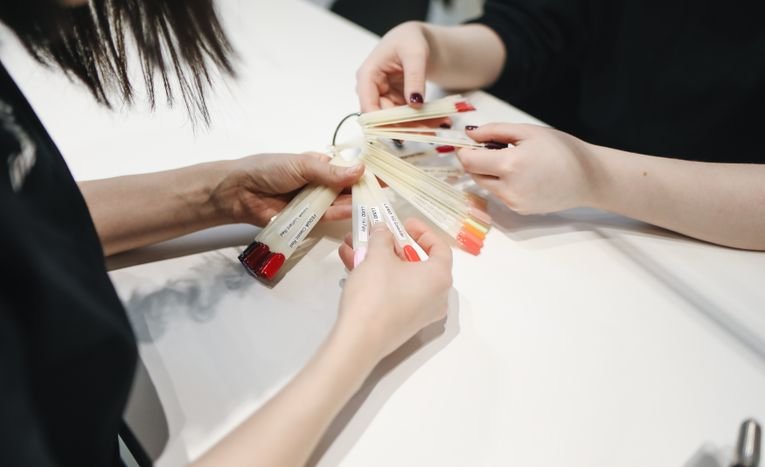
Nail colour trends shift noticeably with the seasons, and knowing what is genuinely popular right now, rather than what was trending a year ago, makes choosing your next manicure far easier. Warm, cosy tones dominate autumn and winter, while spring and summer bring a shift towards lighter, fresher shades. This guide covers what is actually trending for 2026, plus how to pick a shade that suits your skin tone and the season, regardless of what colour family you gravitate towards.
Autumn and winter 2026: warm, cosy tones
Chocolate and cocoa tones are dominating autumn and winter nail trends for 2026, offering a softer, more wearable alternative to classic black while still feeling deliberate and polished. Deep lattes and true chocolate shades work particularly well as a “quiet luxury” look, pairing naturally with gold jewellery and neutral outfits. Rich, cherry-toned reds are also having a moment, offering a warmer, slightly less severe alternative to the classic bright red that has dominated colder-season manicures for years.
Spring and summer 2026: soft pastels with a twist
Pastels remain the defining story of spring, but the finish has shifted meaningfully this year. Rather than flat, opaque pastel colour, sheer, jelly-like finishes are proving more popular, letting the natural nail show through for a softer, watercolour effect. This shift matters for anyone with visible nail ridges or texture, since a sheer finish is considerably more forgiving than a fully opaque one. Soft pistachio green, cloud white, and a dusty cornflower blue are among the standout shades for the season.
Seasonal colour guide at a glance
| Season | Key shades | Best finish |
|---|---|---|
| Autumn/Winter | Chocolate brown, latte, cherry red, deep plum | Glossy or matte, full opacity |
| Spring | Lavender, pistachio, cornflower blue, cloud white | Sheer, jelly-like finishes |
| Summer | Coral, turquoise, hot pink, bright citrus tones | High-gloss, saturated colour |
| Year-round | Nude, soft pink, classic red, white | Any finish, universally flattering |
Choosing a shade that suits your skin tone
For fair skin tones with cooler undertones, cloud white and cornflower blue tend to stand out particularly well, while a rosy-tinted nude also works nicely. When genuinely unsure which shade to reach for, cloud white and cashmere-toned nude are widely considered two of the most universally flattering options across the full range of skin tones, making them safe starting points if you want a colour you can wear regardless of the season or your outfit.
Metallic and chrome finishes remain strong across seasons
Chrome and metallic finishes, in colours ranging from silver and gold to rose gold, continue to feature heavily across seasonal trend reports rather than being tied to any single time of year. These finishes work particularly well layered over the seasonal base colours above, giving a manicure additional dimension without needing to commit to an entirely different colour family each season.
Nail colour by nail length and shape
The same shade can look completely different on short nails and long nails, so shape and length should guide your choice as much as the season does. Short nails suit sheer and nude shades particularly well, because a light, translucent colour makes the nail bed look longer and neater, while very dark colours can make short nails look smaller and stubbier by contrast. If you love dark shades on short nails, a deep cherry or plum with a glossy finish works better than a flat black, since the shine adds depth without overwhelming the nail. Almond and oval shapes are the most forgiving for colour, since their tapered tips suit almost every shade, from pale pastels to rich autumn browns. Square nails suit bold, opaque colours well, because the straight edge gives the colour a clean frame, while coffin and stiletto shapes suit statement shades and chrome finishes that show off the length.
For anyone growing out their nails, a sheer pink or a milky white is a practical choice during the awkward middle stage, since it looks tidy even when the lengths are uneven. Once the nails reach the desired length, deeper seasonal colours become easier to wear, because the extra length balances the richness of the shade. The rule is simple: the shorter the nail, the lighter and sheerer the colour.
At home or in the salon: which finish suits which
Some seasonal finishes are easy to recreate at home, while others are genuinely better left to a salon. Classic glossy colour, sheer jelly finishes and simple metallic polishes are all straightforward at home with a good base coat and top coat. Chrome, cat eye and magnetic finishes are harder, since they need specific application techniques and often a gel base to look their best, so these are worth booking in for if the finish matters to you. Builder gel and gel polish also last far longer when applied professionally, particularly for people whose nails chip easily or who want a manicure to survive a holiday or a busy few weeks. If you do your nails at home, invest in a decent base coat and a quick-dry top coat, since these two products make more difference to how long a manicure lasts than the colour itself.
Carrying one shade across the seasons
You do not need a new shade for every season, and some colours transition beautifully if you change the finish rather than the colour itself. A deep cherry red, for example, works as a glossy opaque shade in autumn and winter, then becomes a sheer wine-stain wash in spring by applying a single thin coat over a clear base. Chocolate brown can be worn opaque and glossy in autumn, then softened in spring with a matte top coat that mutes the depth without changing the colour family. Nude shades are the easiest of all to carry across the year: a warm latte nude suits autumn, a cooler cashmere nude suits winter, and a sheer milky nude suits spring and summer, all without buying a new bottle. This approach also saves money and keeps your polish collection manageable, since a handful of versatile shades covers the whole year.
Festive and party-season nails
December is the one month when bolder nail choices feel entirely appropriate, and metallics come into their own. Gold and silver chrome, glitter top coats and deep jewel tones such as emerald and ruby all suit festive outfits and photograph well in evening light. For work parties, a deep plum or a burgundy shade with a subtle shimmer is a safer choice than a full glitter manicure, since it reads as festive without being distracting. A fresh manicure the day before an event looks considerably better than one done a week earlier, since even the best polish shows wear at the tips after a few days.
Keeping seasonal colour looking good for longer
- Always use a base coat, which protects the nail from staining, particularly with dark autumn and winter shades
- Seal the free edge of the nail with top coat, since this is where chipping starts first
- Wear gloves for washing up and cleaning, because water and detergents are the fastest way to shorten a manicure
- Apply cuticle oil daily, which keeps the skin around the nail tidy and stops the polish lifting at the edges
- Reapply top coat every two or three days to refresh the shine and extend the wear of any seasonal shade
- Remove old polish properly with remover and cotton pads, rather than peeling it off, which damages the nail surface
Frequently asked questions
What nail colour makes nails look longer?
Light, sheer colours and soft pinks tend to create an elongating effect, along with nude shades matched closely to your natural skin tone, since these create less visual contrast at the tip of the nail than darker or more opaque colours.
Are dark nail colours still in style for 2026?
Yes, though the specific shades have shifted. Rather than classic black, deep chocolate browns and rich plum tones are the more current dark options for 2026, offering a similar depth with a softer, warmer edge.
How often do nail colour trends actually change?
Broad seasonal shifts, cosy tones in autumn and winter, pastels in spring, brights in summer, are fairly consistent year on year, though the specific shades and finishes within each season do genuinely evolve, which is why checking current trend reports each season is worth doing if staying current matters to you.
Our recommendation
If you want one versatile shade that works across most of the year, a cashmere-toned nude or a soft, sheer pink is the safest and most flattering starting point for almost any skin tone. If you enjoy following seasonal trends more closely, lean into chocolate and cherry tones for autumn and winter, and switch to sheer pastels as spring approaches, layering in chrome or metallic finishes whenever you want extra dimension without changing your whole colour palette.