
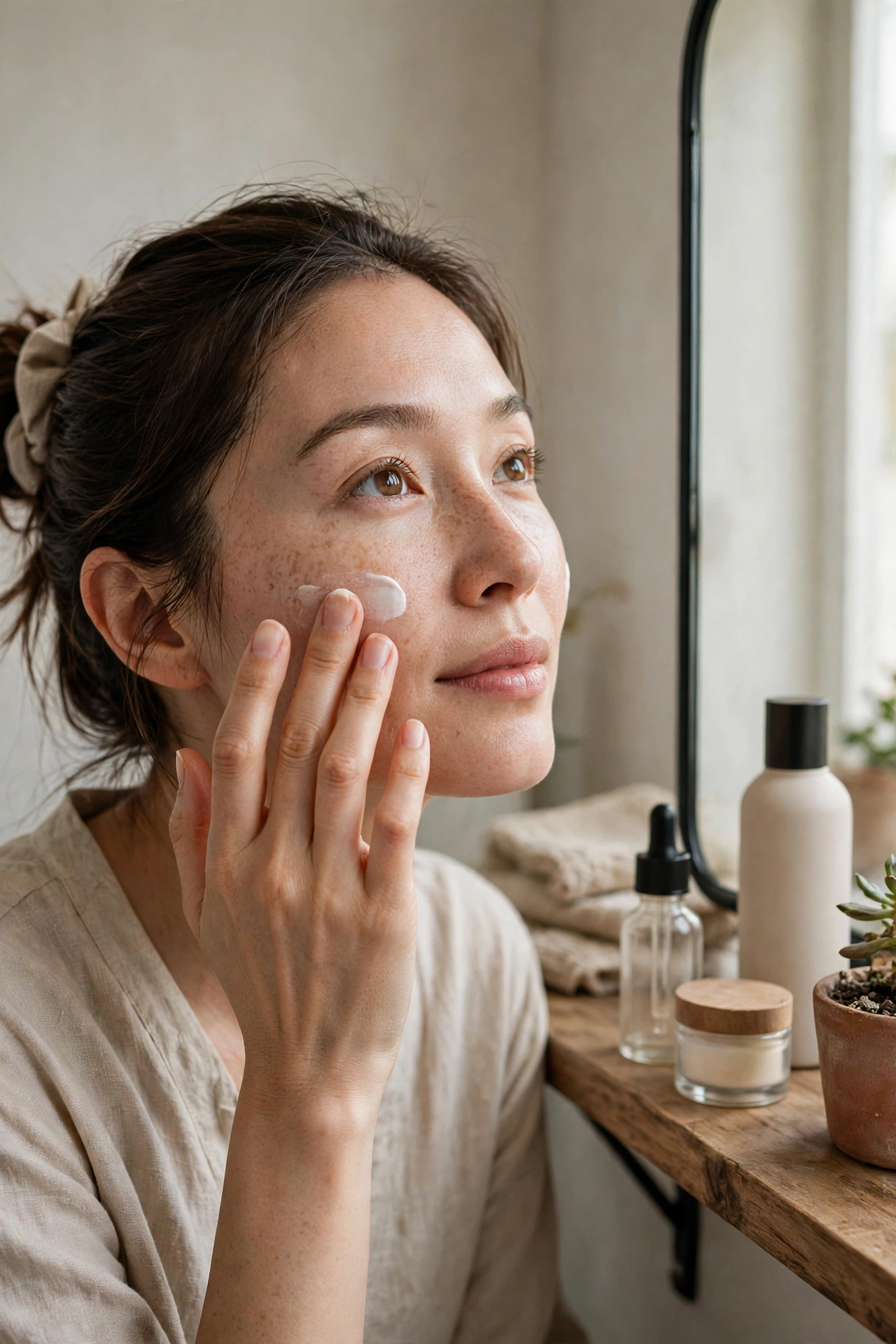
Combination skin is the most common skin type in the UK, and it is also the most confusing to look after. Your forehead, nose and chin feel oily and shiny by midday, while your cheeks feel normal or dry. One product suits one part of your face and does nothing for the other. The answer is not a more expensive routine. It is a simple routine that treats each zone of your face differently.
This guide gives you the best skincare routine for combination skin in the UK, with a morning routine and an evening routine, a zone-based method for the oily T-zone and the drier cheeks, weekly extras such as multi-masking, and budget high-street picks for every step. It answers the question directly first, then works through each step in turn.
The short answer: cleanse gently, treat zones separately, moisturise lightly, and protect in the morning
The best routine for combination skin has four morning steps and five evening steps. In the morning, cleanse with a gentle gel or foam cleanser, apply a light hydrating serum, moisturise lightly, and finish with sunscreen. In the evening, remove makeup and sunscreen, cleanse again, apply a treatment for your main concern, and moisturise. Once or twice a week, add a gentle exfoliant and a face mask, using a different mask on the T-zone and the cheeks. That is the whole routine. Everything else in this guide is how to choose the right product for each step and each zone.
Keep the routine simple at first. Add one new product at a time, and give it two weeks before you judge it. If a product stings, causes redness, or makes your skin break out, stop using it. If a skin problem does not improve, or gets worse, speak to a pharmacist or your GP, or ask for a dermatology referral.
What combination skin is, and how to tell if you have it
Combination skin means your face has two different skin types at once. The T-zone, which is the forehead, nose and chin, produces more oil. It looks shiny by the afternoon, and it is where spots and blackheads usually appear. The cheeks produce less oil. They feel normal, or they feel dry and tight, especially in cold weather or after washing.
You can check your skin type at home with a simple test. Wash your face with a gentle cleanser, pat it dry, and do not apply any product. Wait for one hour, then look in a mirror in daylight and touch your skin. If your forehead and nose look shiny but your cheeks look and feel normal or dry, you probably have combination skin. If your whole face feels tight, you are more likely to have dry skin. If your whole face looks shiny, you are more likely to have oily skin.
Combination skin changes with the seasons in the UK. In summer, the T-zone gets oilier and the cheeks stay normal. In winter, the cheeks get drier while the T-zone stays oily. Central heating, cold wind, and hard water can all make the dry areas worse. Your routine should change with the seasons too, with a richer moisturiser on the cheeks in winter and a lighter one in summer.
| Zone | How it feels | What it needs |
|---|---|---|
| T-zone (forehead, nose, chin) | Oily and shiny by midday, prone to spots and blackheads | A light gel cleanser, a balancing treatment, a light moisturiser, and a mattifying sunscreen |
| Cheeks | Normal or dry, sometimes tight after washing | A gentle cleanser, a hydrating serum, and a slightly richer moisturiser |
| Under the eyes | Thin and delicate, can look tired or dry | A small amount of a gentle eye cream, patted on, not rubbed |
The zone-based method: treat each part of your face differently
The zone-based method is the key idea in this guide. Instead of using one product on your whole face, you use the right product on the right zone. It sounds like more work, but in practice it means using less product on the cheeks and a targeted treatment only where you need it.
Start with the cleanser, which you use on the whole face. After cleansing, apply a hydrating serum to the whole face, because every zone needs water. Then apply your treatment only where it is needed. A product for oil and spots goes on the T-zone only. A richer cream goes on the cheeks only. A light moisturiser can go on the whole face, with a little extra on the cheeks if they feel dry.
Do not use a harsh, drying product on your whole face to fix the T-zone. It will strip the cheeks and make them drier, which can make your skin produce more oil to compensate. Do not use a rich cream on your whole face to fix the cheeks either, because it can block the pores in the T-zone and cause spots. The zone-based method avoids both mistakes.
Morning routine for combination skin
Your morning routine should be light and protective. Its job is to clean off the night, add hydration, and protect your skin from the day. It should take about five minutes.
Step 1: Cleanse. Use a gentle gel or foam cleanser. Massage it over damp skin for about thirty seconds, then rinse with lukewarm water. Avoid hot water, which strips the skin, and avoid a cleanser that leaves your skin feeling tight and squeaky, because that means it has removed too much of your skin’s natural oil. Pat your face dry with a clean towel, do not rub.
Step 2: Hydrate. Apply a light hydrating serum to damp skin. Look for a serum with hyaluronic acid or glycerin, which draw water into the skin. Use two or three drops, press them over the whole face, and let the serum sink in for a minute. This step suits both zones, because even oily skin needs water.
Step 3: Moisturise. Apply a light, oil-free moisturiser to the whole face. If your cheeks feel dry, add a little extra moisturiser there, or use a slightly richer cream on the cheeks only. A gel-cream texture works well for combination skin, because it hydrates without feeling heavy on the T-zone.
Step 4: Protect. Apply sunscreen as the last step every morning, all year round, even on cloudy days. Choose a broad spectrum sunscreen made for the face, with a light texture that does not leave a white cast or a greasy finish. Use about a fingertip length for your face and neck. Sunscreen is the most important step in the morning, because it protects your skin from sun damage, which makes every other skin concern worse.
Evening routine for combination skin
Your evening routine should be thorough and reparative. Its job is to remove the day, including makeup and sunscreen, and to give your skin the treatment it needs overnight. It should take about ten minutes.
Step 1: Remove makeup and sunscreen. Use a cleansing balm, a cleansing oil, or micellar water on a cotton pad. This first cleanse removes makeup, sunscreen, and the dirt of the day. If you wear makeup, this step is essential, because a single cleanser will not remove it all.
Step 2: Cleanse again. Use the same gentle gel or foam cleanser as in the morning. This second cleanse cleans the skin itself. Rinse with lukewarm water and pat dry. This two-step method, known as double cleansing, is the simplest way to get your skin properly clean without scrubbing it.
Step 3: Treat. Apply a treatment for your main concern, only where it is needed. If you have spots or blackheads in the T-zone, apply a treatment with salicylic acid there, two or three times a week to start. If your cheeks feel dull or dry, apply a hydrating serum there instead. Do not use a strong treatment every night when you start. Build up slowly, and stop if your skin becomes red or sore.
Step 4: Moisturise. Apply a light moisturiser to the whole face, with a little extra on the cheeks. In winter, you may want a slightly richer cream on the cheeks. In summer, a gel-cream is usually enough. If your skin feels comfortable and not tight, your moisturiser is doing its job.
Step 5: Eye cream, if you use one. Pat a small amount of a gentle eye cream around the eye area with your ring finger. Use a tiny amount, about the size of a grain of rice for both eyes. Do not rub, and do not apply it too close to the lash line.
| Step | Morning | Evening |
|---|---|---|
| 1 | Gentle gel or foam cleanser | Makeup remover, then the same gentle cleanser |
| 2 | Light hydrating serum | Treatment, on the T-zone or cheeks as needed |
| 3 | Light, oil-free moisturiser | Light moisturiser, extra on the cheeks |
| 4 | Broad spectrum sunscreen | Eye cream, if you use one |
| Weekly | None | Gentle exfoliant and multi-masking, once or twice a week |
Weekly extras: exfoliation and multi-masking
Two weekly steps make a real difference for combination skin, and they are both zone-based. The first is gentle exfoliation. The second is multi-masking, which means using a different mask on each zone at the same time.
Exfoliate once or twice a week, not every day. A chemical exfoliant, such as a product with salicylic acid or lactic acid, is usually gentler than a scrub. Apply it to the T-zone, where dead skin and oil build up, and use it lightly on the cheeks, or skip the cheeks if they feel sensitive. Do not exfoliate on the same night as a strong treatment, and always use sunscreen the next morning, because exfoliated skin is more sensitive to the sun.
Multi-masking is simple. After cleansing, apply a clay mask to the T-zone, where it draws out oil and clears the pores. At the same time, apply a hydrating mask to the cheeks, where it adds moisture. Leave both masks on for ten minutes, then rinse with lukewarm water and moisturise. You can buy two masks, or you can use one mask on each zone. This is the step that makes the biggest visible difference for combination skin, because it treats both zones properly in a single sitting.
Do not overdo the weekly steps. More exfoliation does not mean better skin. If your skin feels sore, looks red, or starts to flake, stop the weekly steps for a week and go back to the basic routine. Your skin barrier needs time to recover.
Budget high-street picks: what to buy for each step
You do not need expensive products for combination skin. The UK high street, including Boots and Superdrug and their own-brand ranges, sells a good cleanser, serum, moisturiser and sunscreen for every step in this routine. Look for simple formulas with few ingredients, and avoid products with a strong fragrance if your skin is sensitive.
For a cleanser, choose a gentle gel or foam cleanser from a high-street own-brand or budget range. It should clean without leaving your skin tight. For a hydrating serum, choose a simple hyaluronic acid serum, which is widely available on the high street at a low price. For a moisturiser, choose a light gel-cream from a high-street range, and a slightly richer cream for the cheeks in winter if you need one.
For sunscreen, choose a facial sunscreen with a light texture, sold by a high-street brand or own-brand range. Try it on the back of your hand first, to check that it does not leave a white cast or feel greasy. For a treatment, choose a salicylic acid product for the T-zone, and use it two or three times a week. For masks, choose a clay mask for the T-zone and a hydrating mask for the cheeks. You do not need a full set from one brand. Mixing products from different high-street ranges is fine, as long as each product suits its zone.
Build your routine one step at a time. Start with a cleanser, a moisturiser and a sunscreen. Add a serum next, then a treatment, then the weekly masks. This keeps the cost down, and it also tells you which product is helping and which one is causing a problem, because you will know exactly when each one was added.
How this routine compares with other routines
If you have read about other routines, you may wonder how this one differs. A 10-step routine, such as the Korean routine, has more steps and more layers, and it can work well, but it is more than most people need for combination skin. Our guide to the 10-step Korean skincare routine explains those steps in full, if you want to try a longer routine. The routine in this article is a shorter version, built around the same principles, but with fewer products and a zone-based approach.
A routine for oily skin is different, because it focuses on controlling oil across the whole face. A routine for dry skin is different too, because it focuses on rich moisture everywhere. Combination skin needs a routine that does both, in different places. That is why the zone-based method matters, and why a routine made for one skin type will not work well for combination skin.
Makeup also sits better on skin that is properly looked after. A good skincare routine gives you a smoother base, so your makeup lasts longer and looks more natural. Our everyday makeup routine for beginners starts with skin prep, and it works best on skin that has been cleansed and moisturised first.
Mistakes to avoid
- Using a harsh cleanser on your whole face: it strips the cheeks and makes the T-zone produce more oil. Choose a gentle cleanser, and let the treatment step do the work on the T-zone.
- Skipping moisturiser because your T-zone is oily: oily skin still needs water. A light, oil-free moisturiser hydrates without adding shine.
- Skipping sunscreen: sun damage makes spots, dryness and uneven tone worse. Use sunscreen every morning, all year round.
- Adding too many new products at once: if your skin reacts, you will not know which product caused it. Add one product at a time, and wait two weeks before adding the next.
- Exfoliating every day: it damages the skin barrier and makes combination skin worse. Exfoliate once or twice a week, and stop if your skin feels sore.
- Using a rich cream on your whole face: it can block the pores in the T-zone and cause spots. Use a light moisturiser overall, with a richer cream on the cheeks only.
- Ignoring the seasons: combination skin changes through the year. Use a richer moisturiser on the cheeks in winter, and a lighter one in summer.
Frequently asked questions
What is the best skincare routine for combination skin?
Cleanse gently morning and evening, apply a light hydrating serum, moisturise lightly, and use sunscreen every morning. In the evening, remove makeup first, then cleanse, treat the T-zone or the cheeks as needed, and moisturise. Add a gentle exfoliant and multi-masking once or twice a week.
Should I use different products on different parts of my face?
Yes, that is the zone-based method. Use a light treatment for oil and spots on the T-zone only, and a hydrating serum or a slightly richer cream on the cheeks only. Use the same gentle cleanser and light moisturiser on the whole face.
What moisturiser is best for combination skin?
A light, oil-free gel-cream moisturiser works well for the whole face. If your cheeks feel dry, use a slightly richer cream on the cheeks only. In winter, you may need a richer cream on the cheeks, while the T-zone stays with the light moisturiser.
Should combination skin use sunscreen every day?
Yes. Use a broad spectrum facial sunscreen every morning, all year round, even on cloudy days. Choose a light texture that does not leave a white cast or a greasy finish, and use about a fingertip length for your face and neck.
How often should I exfoliate combination skin?
Once or twice a week is enough. Use a gentle chemical exfoliant on the T-zone, and use it lightly on the cheeks or skip them if they feel sensitive. Do not exfoliate every day, and always use sunscreen the next morning.
Can I use the same routine in summer and winter?
The steps stay the same, but the products change. In winter, use a richer moisturiser on the cheeks and a heavier cream at night if your skin feels dry. In summer, use a lighter gel-cream and a lighter sunscreen. The T-zone usually needs the same light treatment all year.
Conclusion
Combination skin is easier to look after when you stop treating your whole face as one skin type. Cleanse gently, hydrate everywhere, treat the T-zone and the cheeks separately, moisturise lightly, and protect your skin with sunscreen every morning. Add a gentle exfoliant and multi-masking once or twice a week, and build your routine one high-street product at a time. With that simple, zone-based routine, both parts of your face get what they need.