
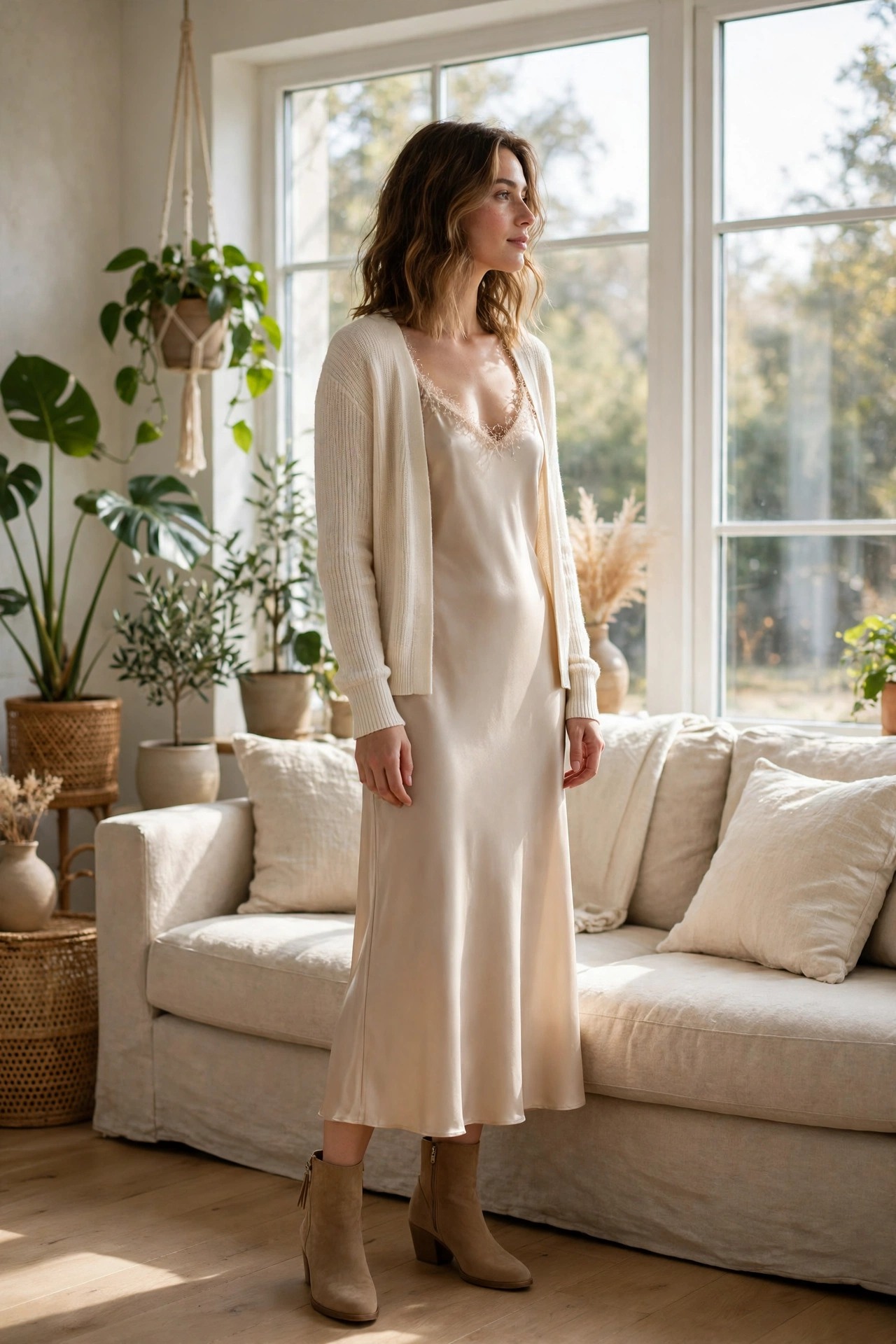
A slip dress is one of the simplest dresses you can own, and one of the most useful in the UK. It is a sleeveless dress with thin straps, cut on the bias so the fabric falls close to the body without clinging. It works for a casual day, a smart office, and an evening out, but only if you style it for the occasion and the weather. Worn on its own in January, it looks unfinished. Worn with the right layers, it can carry you through the whole year.
This guide shows you how to style a slip dress in the UK, with casual, office and evening looks, autumn and winter layering, what to wear underneath, shoe pairings, and fit advice for different body types.
The short answer: layer it for the season, then dress it up or down with shoes
To style a slip dress in the UK, start with the weather. On a warm day, wear it on its own with flat sandals or trainers. In cooler weather, layer a T-shirt, a fine knit, or a turtleneck underneath, and add a cardigan, a blazer, or a coat on top. For the office, choose a midi length in a plain colour and pair it with a blazer and closed shoes. For the evening, keep it simple, add heeled shoes and a small bag, and let the dress do the work.
The dress itself should fit well before you add anything. The straps should sit on your shoulders without slipping, the hem should fall where you want it, and the fabric should skim rather than cling. Once the fit is right, the styling is easy: change the layers and the shoes, and the same dress becomes a different outfit.
What a slip dress is, and how to choose the right one
A slip dress is a simple, sleeveless dress with thin spaghetti straps and a straight or slightly flared skirt. It is usually cut on the bias, which means the fabric is cut at an angle so it drapes and moves with the body. Most slip dresses are made from satin, silk, viscose, or a silky polyester. The finish is smooth, with a soft sheen, and the shape is deliberately plain, which is what makes it so easy to style.
When you choose one, start with the length. A midi length, falling below the knee or to mid calf, is the most useful in the UK. It works for the office, for evenings, and for cooler days with boots. A mini length suits casual summer days and evenings, but it is harder to layer and harder to wear to work. A maxi length looks elegant for evenings, but it can be impractical on wet pavements.
Choose the fabric for the season you will wear it most. A heavier satin or a lined viscose holds its shape and works through autumn and winter with layers. A light silk or a thin satin suits summer and evenings. Check the lining, because an unlined slip dress in a light fabric can be see-through in daylight. A lined dress is warmer, more modest, and easier to wear without worrying about what shows through.
Choose a colour you will actually wear. Black is the most useful, because it works for every occasion and every season. Navy, dark green, and burgundy are good alternatives for autumn and winter. A soft neutral, such as champagne or stone, suits spring and summer. A bold colour or a print can look striking, but it is harder to style in different ways, so it is better as a second slip dress than as your first.
| Length | Best for | Watch out for |
|---|---|---|
| Mini | Summer days, evenings, holidays | Hard to layer, not suitable for most offices |
| Midi | Office, evenings, all seasons with layers | Check the hem does not sit at the widest part of the calf |
| Maxi | Evenings, weddings, formal occasions | Can drag on wet pavements, needs a heel or a shorter coat |
How to style a slip dress for a casual day
For a casual day, keep the outfit relaxed and comfortable. The slip dress does the elegant part, so everything else can be simple.
Wear the dress on its own in warm weather, with flat sandals or white trainers. A pair of simple trainers makes a slip dress look relaxed rather than dressed up, and it is practical for walking, shopping, and a day out.
On a cooler day, layer a plain T-shirt underneath. A white T-shirt under a black slip dress is a classic combination, and it works for most casual days. Tuck nothing in, because there is nowhere to tuck it. The T-shirt should sit flat under the dress, with no bunching at the waist.
Add a denim jacket or a soft cardigan on top. A denim jacket gives the outfit a casual edge and adds warmth without hiding the dress. A long cardigan works well on a cool day, especially in a soft knit. Keep the bag simple, such as a cross-body bag or a canvas tote, and keep jewellery light.
How to style a slip dress for the office
A slip dress can work for the office, but it needs more structure than a casual look. The aim is to make the dress look like a smart work outfit, not like an evening dress worn to work.
Choose a midi length in a plain, dark colour, such as black, navy, or dark green. Avoid very light colours, bright prints, and shiny fabrics for a formal office. A matte satin or a lined viscose looks smarter than a high-shine silk. Make sure the straps are covered, because bare shoulders are not suitable for most offices.
Layer a fine knit or a fitted shirt underneath. A thin roll neck in a neutral colour works well in autumn and winter, and it keeps you warm. In warmer months, a fitted short sleeve top or a fine knit T-shirt under the dress gives coverage without adding bulk. Choose a top in a plain colour that matches or complements the dress.
Wear a blazer on top. A fitted blazer that ends at the hip gives the outfit structure, and it covers the straps completely. A black blazer over a black slip dress looks smart and simple. A navy blazer over a navy dress works the same way. Keep the blazer buttoned or open, but make sure the dress underneath stays neat.
For shoes, choose closed shoes, such as pointed flats, loafers, or low heels. Avoid open sandals and trainers in a formal office.
How to style a slip dress for the evening
For the evening, a slip dress needs very little styling. The dress is already elegant, so the rest of the outfit should stay simple and let it stand out.
Wear the dress on its own, without a top underneath, and add a light layer only if the evening is cool. A fitted cardigan, a cropped jacket, or a soft shawl can add warmth without hiding the dress. A leather jacket gives a sharper edge for a night out, and it works well with a black slip dress.
Choose heeled shoes, such as heeled sandals, pointed court shoes, or heeled boots in winter. A heel lifts the hem and gives the outfit a finished look. If you prefer flats, choose a pointed flat in a similar colour to the dress, so the leg line stays clean.
Keep jewellery simple but deliberate. A pair of small earrings, a fine necklace, or a single bracelet is enough. A small clutch or a chain bag completes the look. Avoid carrying a large daytime bag, which makes an evening outfit look unfinished.
Autumn and winter layering: how to wear a slip dress all year
Layering is what makes a slip dress work in the UK, where the weather changes through the day and through the year. The trick is to add warmth without adding bulk, and to keep the layers in the right order.
Start with a layer underneath. A fine turtleneck is the best winter layer, because it adds warmth and covers the shoulders and arms. A long sleeve T-shirt works for milder days, and a thin knit jumper worn under the dress gives a relaxed, cosy look. Choose a fitted layer, because a loose layer will bunch under the dress and spoil the line.
Add a layer on top. A long cardigan, a chunky knit worn open, or a blazer all work. In cold weather, add a coat. A long wool coat over a slip dress looks smart, and it keeps you warm. A shorter coat, such as a cropped jacket, works with a midi dress, but it can look unbalanced with a maxi dress, so check the proportions in a mirror.
Wear tights and boots in winter. Opaque tights in black or navy keep you warm and make a slip dress look like a winter outfit. Pair them with ankle boots or knee high boots. A knee high boot under a midi dress is a classic winter combination, and it covers the gap between the hem and the shoe.
For a bolder winter look, wear the slip dress over trousers. A pair of straight or wide leg trousers under a midi slip dress creates a layered outfit that is warm and modern. Keep the trousers slim enough to sit flat under the dress, and choose a top layer that ties the outfit together, such as a long coat.
| Season | Layer underneath | Layer on top | Shoes |
|---|---|---|---|
| Spring | Plain T-shirt or fine knit | Denim jacket or light cardigan | Trainers or ankle boots |
| Summer | Nothing, or a thin camisole | Nothing, or a light shawl | Flat sandals or heeled sandals |
| Autumn | Long sleeve top or thin roll neck | Blazer or long cardigan | Ankle boots or loafers |
| Winter | Turtleneck and opaque tights | Long wool coat | Knee high boots or heeled boots |
What to wear underneath a slip dress
What you wear underneath a slip dress matters, because the fabric is thin and the shape is close to the body. The wrong underwear will show through, and the wrong layer will spoil the line.
Choose seamless underwear in a colour close to your skin tone. A nude or skin tone bra and pants will not show through a light coloured dress. Avoid white underwear under a white or light dress, because white shows through more than a skin tone colour. Avoid lace or heavy seams, which can show through a thin fabric.
For support, choose a bra that suits the dress. A strapless bra works if the dress has enough structure to hold it in place, but many slip dresses have thin straps that do not cover a bra strap. A bra with clear straps is an option, but it can look untidy. A better choice is often a built-in bra, a slip with support, or a dress with a built-in shelf bra, if the dress offers it.
For warmth and modesty, a thin camisole or a slip underneath can help. A full length slip in a skin tone colour smooths the line and stops the dress from clinging. A camisole under a slip dress is useful if the dress is slightly sheer, but it should sit flat and not add bulk at the waist.
Shoe pairings for a slip dress
Shoes change the whole feel of a slip dress. The same dress can look casual, smart, or dressed up, depending on what you wear on your feet.
For a casual day, choose white trainers, flat sandals, or simple ballet flats. Trainers make the dress look relaxed, and they are practical for a long day. Flat sandals suit warm days and holidays. Ballet flats work for a smart casual look, especially in a plain colour.
For the office, choose pointed flats, loafers, or low heels. A pointed toe keeps the outfit looking smart, and a low heel adds a little height without making a long day uncomfortable. Avoid trainers and open sandals in a formal office.
For the evening, choose heeled sandals, pointed court shoes, or heeled boots. A heel gives the outfit a finished look and lifts the hem off the floor. If you prefer flats, choose a pointed flat in a dark colour, so the outfit still looks dressed up.
For autumn and winter, choose ankle boots or knee high boots. A slim ankle boot works with a midi dress, and a knee high boot works with a midi or a maxi dress. Avoid very chunky boots, which can make a light dress look bottom heavy.
Fit advice for different body types
A slip dress suits most body types, because the bias cut drapes rather than clings. A few small adjustments make it work better for your shape.
If you are petite, choose a midi length that falls below the knee, and have the straps shortened if they slip. A shorter hem and a fitted layer underneath help to lengthen the frame. Avoid a maxi length in a heavy fabric, which can overwhelm a small frame. Keep the shoes simple, with a pointed toe or a small heel.
If you are tall, a maxi length works well, and you can wear a midi length with flat shoes without it looking short. A longer coat over a midi dress looks balanced on a tall frame.
If you are curvy, choose a slip dress with a little stretch, and check that the fabric does not pull across the hips. A midi length with a slight flare at the hem gives a balanced shape. A layer underneath, such as a fitted T-shirt or a thin knit, can smooth the line. Avoid a very tight fit, which will show every seam underneath.
If you have a straight figure, a slip dress with a belt or a tied waist can add shape. A thin belt at the waist defines the figure without adding bulk. A dress with a cowl neck or a draped detail at the front also adds interest. For more help choosing dress shapes for your figure, see our guide to summer dresses by shape, which covers flattering fits by body shape.
Mistakes to avoid
- Wearing a slip dress with nothing underneath in cold weather: it looks unfinished and you will be cold. Layer a turtleneck or a fine knit underneath, and add a coat on top.
- Choosing the wrong underwear: white or lacy underwear shows through a thin fabric. Choose seamless underwear in a skin tone colour, and check the dress in daylight.
- Wearing a loose layer underneath: a baggy T-shirt or a loose jumper will bunch under the dress. Choose a fitted layer that sits flat.
- Pairing a slip dress with very chunky shoes: a heavy boot or a bulky trainer can make a light dress look bottom heavy. Choose a slim shoe or a pointed toe.
- Wearing a shiny satin dress to a formal office: a high-shine fabric looks like evening wear. Choose a matte satin or a lined viscose for work, and cover the straps with a blazer.
- Ignoring the straps: straps that slip or dig in will spoil the whole outfit. Have them shortened or lengthened by a tailor if needed.
- Skipping a trial with your real shoes and layers: the hem and the fit depend on what you wear with the dress. Try the full outfit on together, not just the dress on its own.
Frequently asked questions
Can you wear a slip dress in winter?
Yes. Layer a turtleneck or a fine knit underneath, add opaque tights and boots, and wear a long wool coat on top. A heavier satin or a lined viscose works best in winter, because it holds its shape and keeps you warmer.
What do you wear under a slip dress?
Wear seamless underwear in a skin tone colour, so nothing shows through the thin fabric. For warmth or modesty, add a thin camisole or a full length slip underneath. For a layered look, wear a fitted T-shirt, a fine knit, or a turtleneck under the dress.
Can you wear a slip dress to work?
Yes, if you choose a midi length in a plain, dark colour and cover the straps. Layer a fine knit or a fitted shirt underneath, wear a blazer on top, and choose closed shoes such as pointed flats, loafers, or low heels.
Are slip dresses suitable for older women?
Yes. A midi length in a plain colour, layered with a fine knit underneath and a blazer or a long cardigan on top, is a smart and comfortable outfit at any age. Choose a heavier fabric and a modest length, and avoid very thin straps if you prefer more coverage.
What shoes go with a slip dress?
White trainers or flat sandals for a casual day, pointed flats or loafers for the office, heeled sandals or court shoes for the evening, and ankle boots or knee high boots for autumn and winter. Choose a slim shoe that keeps the outfit balanced.
How do you stop a slip dress from clinging?
Choose a lined dress in a heavier fabric, wear a thin slip underneath, and avoid very clingy fabrics on humid days. A light spray of water on the inside of the dress can help if static is the problem, and a fitted layer underneath stops the dress from sticking to the skin.
Conclusion
A slip dress earns its place in a UK wardrobe because it changes with the layers and the shoes. On its own with sandals, it is a summer dress. With a T-shirt underneath and trainers, it is a casual day outfit. With a turtleneck, a blazer, and closed shoes, it is a work outfit. With heels and a small bag, it is an evening outfit. Choose a midi length in a plain colour, check the fit and the lining, and build your outfits around the season. One good slip dress can cover the whole year.