
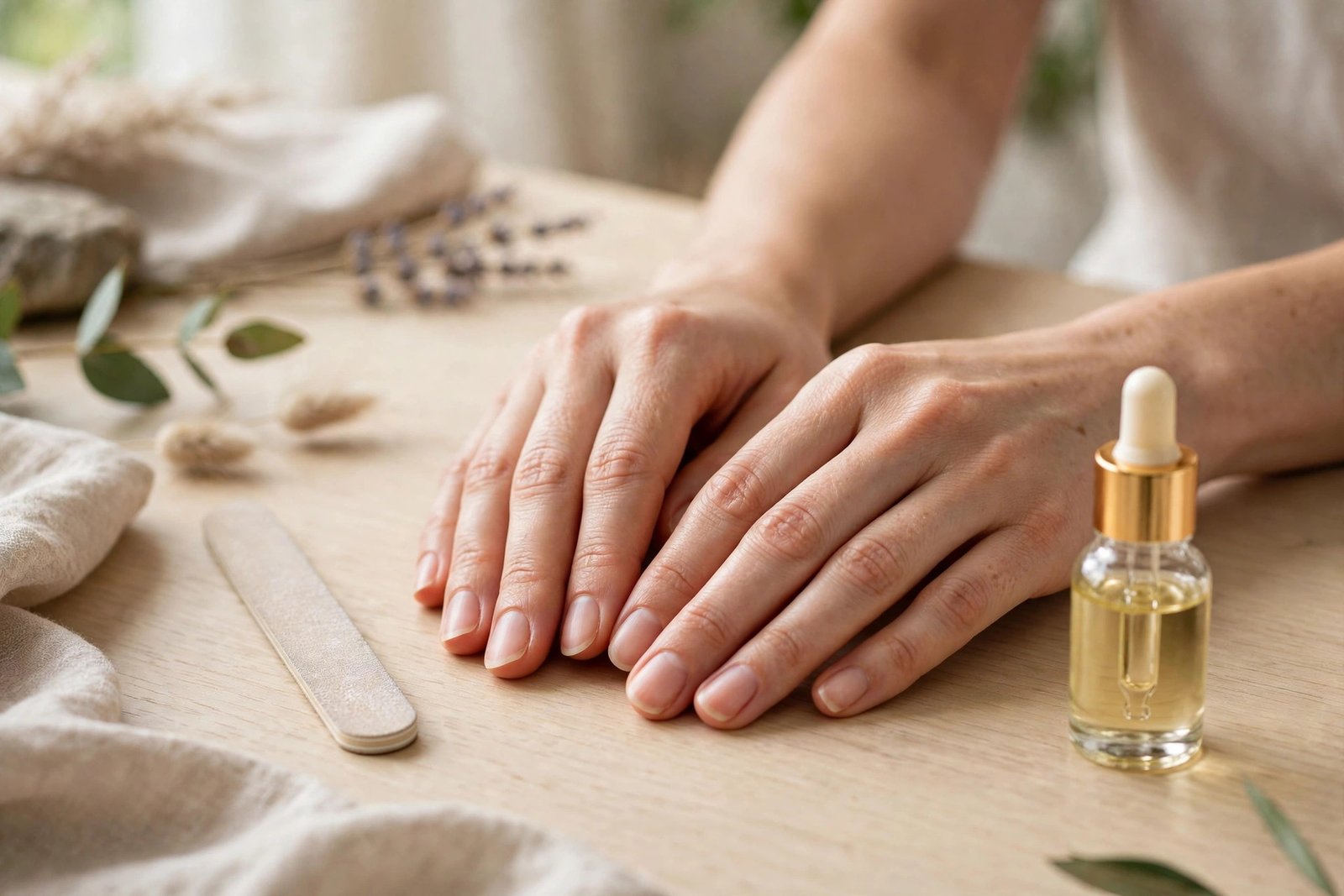
You have taken your acrylics off and your natural nails look thin, bendy, and sore. That is common, and it is usually fixable with a calm routine and time. You do not need an expensive rescue kit. You need to protect the nail you have, keep it flexible, and let a healthy nail grow out.
Direct answer
To repair damaged nails after acrylics, trim them short, file gently in one direction with a glass file, apply cuticle oil daily, use a flexible repair strengthener two to three times per week, wear gloves for wet work, and leave a break of at least three to four weeks before another hard enhancement. If a nail is very painful, swollen, discoloured, or lifting from the nail bed, see your GP or a podiatrist instead of covering it.
What damaged nails after acrylics actually look like
Not all damage is the same. Your routine depends on what you can see and feel.
Thin and bendy nails
The nail plate feels soft and bends when you press it. This often follows over filing or rough removal. Thin nails need protection, not hardness. A rigid strengthener can make them snap.
Peeling and splitting layers
The free edge splits into thin layers, like paper peeling apart. Picking at the loose layers pulls off more of the nail. Keep the edge smooth and short so it cannot catch.
Ridges and rough patches
The surface feels uneven. Light ridges often grow out. Do not buff them flat. Buffing removes thickness you cannot afford to lose while the nail is thin.
White spots, dryness, and soreness
White marks, dryness, and tenderness are common after acetone soaking and filing. Soreness that fades in a day or two is different from pain that gets worse. Pain that gets worse needs a professional check.
Signs that need a GP or podiatrist, not a cosmetic fix
See your GP or a podiatrist promptly if you notice:
- A nail lifting away from the nail bed
- Swelling, spreading redness, warmth, or pus around a nail
- Dark green, black, or brown discolouration that does not grow out
- Severe or increasing pain
- A suspected fungal infection that is spreading or not improving
Do not cover these signs with polish, BIAB, or a new set. For fungal concerns, read our guide to fungal nail infections.
Why acrylics damage nails
Damage rarely comes from one cause. It usually comes from a mix of these factors.
Removal damage. Peeling, pulling, or prising acrylics off lifts layers of the natural nail with them. This is the most common cause of sudden thinness and peeling. Safe removal matters more than any repair product. If you still need to take a set off, follow our guide to safe gel and acrylic removal.
Over filing. Filing the natural nail too hard, too often, or with a coarse file thins the plate. An e-file used with too much pressure can do the same damage faster.
Acetone drying. Acetone soaking dries the nail and the skin around it. Dry nails lose flexibility and split more easily. That is why oil and hand cream matter so much in recovery.
No break between sets. Back to back sets give the nail no time to recover. Even a well applied set adds stress at the free edge. A short break lets the weakest part grow out.
Length and leverage. Long extensions put more leverage on the nail. A knock that would be minor on a short nail can bend or crack a long one.
First 48 hours after removal: what to do
The first two days set the tone. Keep it simple and gentle.
- Trim nails short with clippers, then smooth the edge with a glass file in one direction. For tool choice, see our guide to nail clippers and files for thick or sensitive nails.
- Wash hands with lukewarm water and a mild soap. Pat dry. Avoid long soaks.
- Massage a small drop of cuticle oil into each nail and the skin around it. Jojoba based oil is a good everyday choice because it absorbs well.
- Apply hand cream after washing. This keeps the nail flexible.
- Do not buff, do not pick, and do not apply a new set. Let the nail rest.
- Wear gloves for washing up, cleaning, and any wet work.
If nails feel sore, skip polish for a day or two. A bare, short nail with oil is better than a polished nail that hides pain.
Week by week recovery plan
Nails grow slowly. You will see the free edge improve in weeks, while the base takes months to fully replace. Judge progress by the new growth near the cuticle, not by the old damaged tip.
Weeks 1 to 2: Protect and hydrate
Goal: stop further damage.
- Keep nails short. File only to smooth snags.
- Apply cuticle oil once or twice daily.
- Use a flexible repair strengthener two to three times per week, not daily.
- Wear gloves for wet work and cleaning.
- Avoid peeling, picking, and using nails as tools.
- Skip hard enhancements. A clear polish is fine if the nail is not sore.
Weeks 3 to 4: Strengthen and test
Goal: rebuild resilience.
- If peeling has slowed and soreness has gone, keep the same routine.
- You can add an overnight treatment once or twice a week: oil, then cotton gloves.
- If nails still bend and peel badly, extend the break. Do not rush to a new set to hide the problem.
- Start to notice which nails recover fastest. Thumbs and index fingers often take more knocks, so they may lag behind.
Weeks 5 to 8: Rebuild and decide
Goal: decide what comes next.
- By now the new growth near the cuticle should look smoother and feel firmer.
- If the new growth is healthy, you can consider a gentle overlay. See the BIAB decision table below.
- If peeling, ridges, or soreness persist, keep the break going and speak to a nail technician or your GP.
- Keep oiling daily. This is the habit that pays off over months, not days.
Beyond 8 weeks: Maintain
Goal: keep healthy nails healthy.
- Return to a normal manicure routine slowly.
- Keep nails at a length your daily life allows.
- Keep cuticle oil in your routine, even when nails look good.
- Book infills on time. Late infills increase leverage and lifting.
Your daily repair routine (step by step)
Use this routine morning and evening. It takes a few minutes.
Morning:
- Wash hands, pat dry.
- Massage one small drop of cuticle oil into each nail.
- If you use a strengthener, apply a thin coat on repair days only.
- Apply hand cream.
Evening:
- Remove any polish gently. Avoid scraping.
- Massage cuticle oil into each nail and cuticle.
- Apply hand cream.
- Wear cotton gloves overnight once or twice a week if nails are very dry.
Throughout the day:
- Wear gloves for dishes, cleaning, and gardening.
- Use your knuckles or a tool to open tins, boxes, and cans, not your nails.
- File a snag as soon as it appears, before it tears further.
For your wider setup, see our home manicure station guide for lighting, tools, and storage that make gentle care easier.
Strengtheners: how to use them without making nails brittle
Strengtheners help, but only when used correctly. The most common mistake is using them every day for months.
Choose flexible, not rigid. Look for a repair or flexible strengthener, not an ultra hard formula. Flexible formulas support the nail while it bends. Rigid formulas can make a thin nail snap.
Use two to three times per week. Apply a thin coat on repair days. Remove and reapply as the product directs. Daily layering can build up a stiff shell that cracks.
Stop if nails get worse. If nails become more brittle, dry, or sore after a strengthener, stop using it. Return to oil and hand cream only, then try a different formula later if needed.
Do not rely on a strengthener alone. Oil, short length, gloves, and time do most of the work. A strengthener is support, not a cure.
Avoid DIY hardeners with unknown ingredients. Stick to reputable UK retailers and follow the product instructions. If you have sensitive skin, allergies, or a nail condition, patch test and speak to a pharmacist or your GP first.
Should you use BIAB or gel while your nails recover?
This is the question most people get wrong. BIAB can protect weak nails, but only at the right time and in the right condition. Use this table to decide.
| Situation | Best choice | Why |
|---|---|---|
| Nails are sore, painful, swollen, or lifting | Full break, see a professional | Covering pain hides a problem that needs checking |
| Heavy peeling and very thin nails, first 2 to 3 weeks | Full break with oil and strengthener | The nail needs to calm down before any overlay |
| Peeling has slowed, no pain, new growth looks smoother | Thin soak off BIAB overlay by a trained technician | A flexible overlay can act like a light cast while nails grow |
| You want length straight away | Wait | Length adds leverage and risks another setback |
| You want colour only | Clear polish or a gentle gel polish on healthy nails | Colour without structure is lower risk than a full extension |
If you choose BIAB, ask for a thin, soak off overlay, gentle prep, and no aggressive filing. Removal must be by soaking, not peeling. For the basics, read our guide to BIAB builder gel.
If you are choosing your next set after recovery, compare options in our acrylic vs gel-X extensions guide before you book.
Mistakes that slow recovery
Avoid these common setbacks:
- Peeling off old product. This pulls nail layers away. Always soak off.
- Picking at peeling layers. Smooth the edge with a file instead.
- Over buffing. Buffing does not repair ridges. It thins the nail.
- Daily strengthener layering. This can make nails stiff and brittle.
- Long soaks in hot water. Water swells the nail, then it shrinks as it dries. That cycle weakens it.
- Skipping gloves. Dish soap, cleaning sprays, and long wet work dry and stress thin nails.
- Getting a new set too soon. A new set can hide damage for a few weeks, then reveal a weaker nail underneath.
- Using nails as tools. Opening cans, scraping labels, and prising lids all cause micro breaks.
Food, supplements, and realistic expectations
Healthy nails need time and steady care. No food or supplement repairs a damaged nail overnight.
A balanced diet with protein, iron, zinc, and B vitamins supports normal nail growth, as it supports skin and hair. If you eat a varied diet, you are likely covering the basics. If you have a restricted diet, a health condition, or you are considering a supplement, speak to your GP or pharmacist first. Do not take high dose biotin or other supplements on the basis of a blog post alone. Some supplements can affect lab tests, so tell your clinician if you use them.
Be wary of before and after photos that promise fast regrowth. Nail growth is slow and steady. Your best evidence is the new, smoother growth near the cuticle after three to four weeks, not a dramatic change in a few days.
When to see a GP, podiatrist, or salon
Use this split to decide who to contact:
See your GP or a podiatrist if: a nail is lifting, swollen, very painful, discoloured in a way that does not grow out, or you suspect infection or a fungal problem. A podiatrist can advise on nail health, and your GP can check for causes that need medical care.
See a trained nail technician if: nails are thin and peeling but not painful, you want a safe BIAB overlay after the early recovery period, or you want help with safe removal and gentle shaping. A good technician will tell you to wait if your nails are not ready.
Seek urgent care if: pain worsens quickly, redness spreads, you develop a fever, or a nail injury bleeds heavily or looks infected. Do not wait for a routine appointment in these cases.
This article is general information, not medical advice. If you are unsure, get a professional check.
How to prevent damage next time
Prevention starts at your next appointment, not after damage appears.
- Choose length you can live with. Shorter sets last better and break less.
- Ask for gentle prep and soak off removal. Confirm this before you book.
- Book infills on time, usually every two to three weeks.
- Never peel, pick, or pull a lifting enhancement. Book a repair or a safe removal.
- Keep cuticle oil in your routine between appointments, not just after damage.
- Wear gloves for wet work and cleaning, even when nails look strong.
- Tell your technician if a set felt sore, tight, or heavy. That feedback helps them adjust prep and product.
- If you switch systems, compare them first. Our acrylic vs gel-X guide and our guide to UV vs LED nail lamps can help you ask better questions at the salon.
Frequently asked questions
How long do damaged nails take to recover after acrylics?
Most people see the free edge improve in three to four weeks with a steady routine. Full replacement of a fingernail takes months, so the base may take longer to look fully healthy. Judge progress by the new growth near the cuticle.
Should I leave my nails bare after acrylics?
A short break with bare nails, oil, and a flexible strengthener is the safest start. If nails are not sore, a clear polish is fine. Avoid a hard enhancement until peeling has slowed and soreness has gone.
Is cuticle oil enough on its own?
Cuticle oil is the single most useful daily habit, but it works best with short length, gentle filing, gloves, and a break from hard enhancements. Oil alone cannot undo peeling caused by pulling product off.
Can I use a nail strengthener every day?
No. Most people do better with two to three times per week. Daily layering can make nails stiff and more likely to snap. If nails feel more brittle after a strengthener, stop and return to oil only.
Can I use BIAB straight after acrylics?
Not straight away. Wait until soreness has gone and peeling has slowed, usually at least two to three weeks. Then ask a trained technician for a thin, soak off BIAB overlay with gentle prep.
Why are my nails still peeling after a month?
Peeling can persist if the nail is still too long, if you are picking at layers, if removal was rough, or if a strengthener is too rigid. Shorten nails, stop picking, switch to a flexible strengthener, and keep oiling daily. If peeling does not improve, speak to a nail technician or your GP.
Should I take biotin for damaged nails?
Do not start a high dose supplement on the basis of a blog post. A balanced diet supports normal nail growth. If you are considering a supplement, speak to your GP or pharmacist first, and tell your clinician if you use one, because it can affect some lab tests.
What should I do if my nail lifts from the nail bed?
Do not cover it with polish or an enhancement. Keep it clean and protected, and see your GP or a podiatrist promptly. Lifting can have several causes, and it needs a professional check.
Conclusion
Damaged nails after acrylics recover best with a simple plan: short nails, daily cuticle oil, a flexible strengthener two to three times per week, gloves for wet work, and a break of at least three to four weeks before another hard enhancement. Watch the new growth near the cuticle. That is your real progress. If a nail is painful, swollen, discoloured, or lifting, get a professional check instead of covering it. When you are ready for your next set, choose gently and protect the healthy nail you have rebuilt.
For more nail care, explore our nail care and nail art guides.