
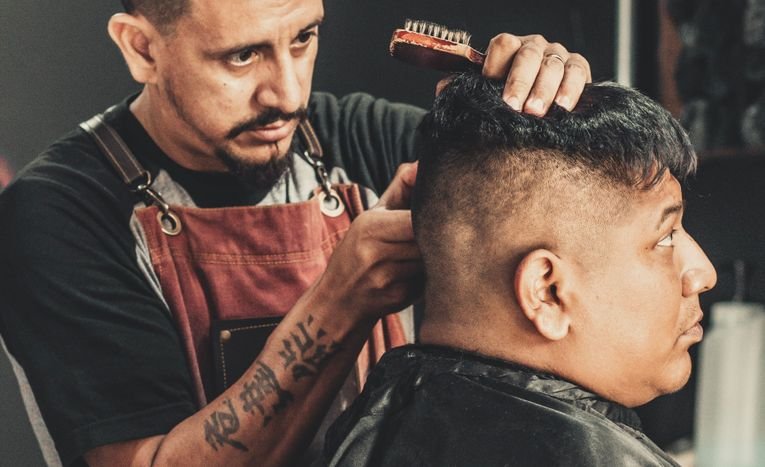
Walking into a barbershop with a photo of your favourite footballer’s haircut is a common approach, and a common way to end up disappointed. The style that suits someone else’s face depends heavily on their bone structure, not just the cut itself. Understanding your own face shape first makes it far easier to explain what you want, and far more likely you will leave happy with the result. This guide breaks down the main face shapes and the hairstyles that genuinely work with each one.
How to work out your face shape
Stand in front of a mirror and look at the relationship between three measurements: the width of your forehead, the width of your cheekbones, and the width of your jawline, alongside the overall length of your face. An oval face is longer than it is wide, with a gently rounded jaw. A round face has similar width and length with soft, undefined angles. A square face has strong, angular jaw and forehead measurements that are roughly equal. Once you have a rough sense of these proportions, the shape categories below become much easier to place yourself into.
Hairstyles by face shape
| Face shape | Key features | Best hairstyles |
|---|---|---|
| Oval | Longer than wide, gently rounded jaw | Most styles work well, including pompadours, crops and undercuts |
| Round | Similar width and length, soft angles | Height on top with shorter sides, such as a textured quiff or high fade, to elongate the face |
| Square | Strong, angular jaw, equal proportions | Textured crops that soften the jawline rather than emphasise it further |
| Heart | Wide forehead, narrow, sometimes pointed chin | Medium-length styles with texture that add width lower down, such as a side-swept fringe |
| Diamond | Narrow forehead and jaw, wide cheekbones | Longer, layered styles that soften angular cheekbones |
| Triangle | Wider jawline, narrower forehead | Volume and layering on top to balance the lower half of the face |
The general principle behind every recommendation
Nearly every face shape recommendation comes down to one idea: balance. Wherever your face is widest, a good haircut avoids drawing further attention to that width, and instead adds volume, texture or length to the narrower areas to even things out. This is why round faces benefit from height on top, and why heart-shaped faces benefit from styles that widen the jaw area rather than the forehead, which is already the widest point.
Diamond face shapes need a slightly different approach
Diamond face shapes are less common and can be trickier to style well, since both the forehead and jawline are narrower than the cheekbones. Short, blunt cuts tend to accentuate this angularity rather than balance it. Longer, layered styles work better here, softening the sharper cheekbone area and adding a sense of length that makes the overall face appear closer to oval.
Working with a barber, not just a photo
A photo reference is a useful starting point, but a good barber will adapt any style to your specific hair density, growth pattern and face shape rather than replicating a photo exactly. Being upfront about your face shape, or simply describing your forehead, cheekbone and jaw proportions, gives a barber far more to work with than a single reference image alone, and tends to produce a result that suits you individually rather than someone else’s bone structure.
Frequently asked questions
Can a hairstyle actually change how my face shape looks?
A hairstyle cannot change your underlying bone structure, but volume, length and texture can visually balance proportions, making a round face appear more elongated or a heart-shaped face appear more even, for example.
What if my face shape falls between two categories?
This is common, since few faces fit a single category perfectly. In this case, take the recommendations from both closest shapes as a starting point and discuss the specifics with your barber, who can assess your proportions in person more accurately than any online guide.
Do glasses change which hairstyle suits a face shape?
Yes, to some extent. Thick or angular frames can add visual weight to the upper face, which is worth factoring in alongside face shape, particularly for round or square faces where too much additional width on top can feel unbalanced.
Our recommendation
Work out your face shape using the forehead, cheekbone and jawline comparison above, then bring that description, alongside a photo reference if you like, to your next barber appointment. Focusing on balance rather than replicating a specific celebrity style gives a far more reliable result, since the same haircut can look completely different depending on the underlying face shape it is applied to.