
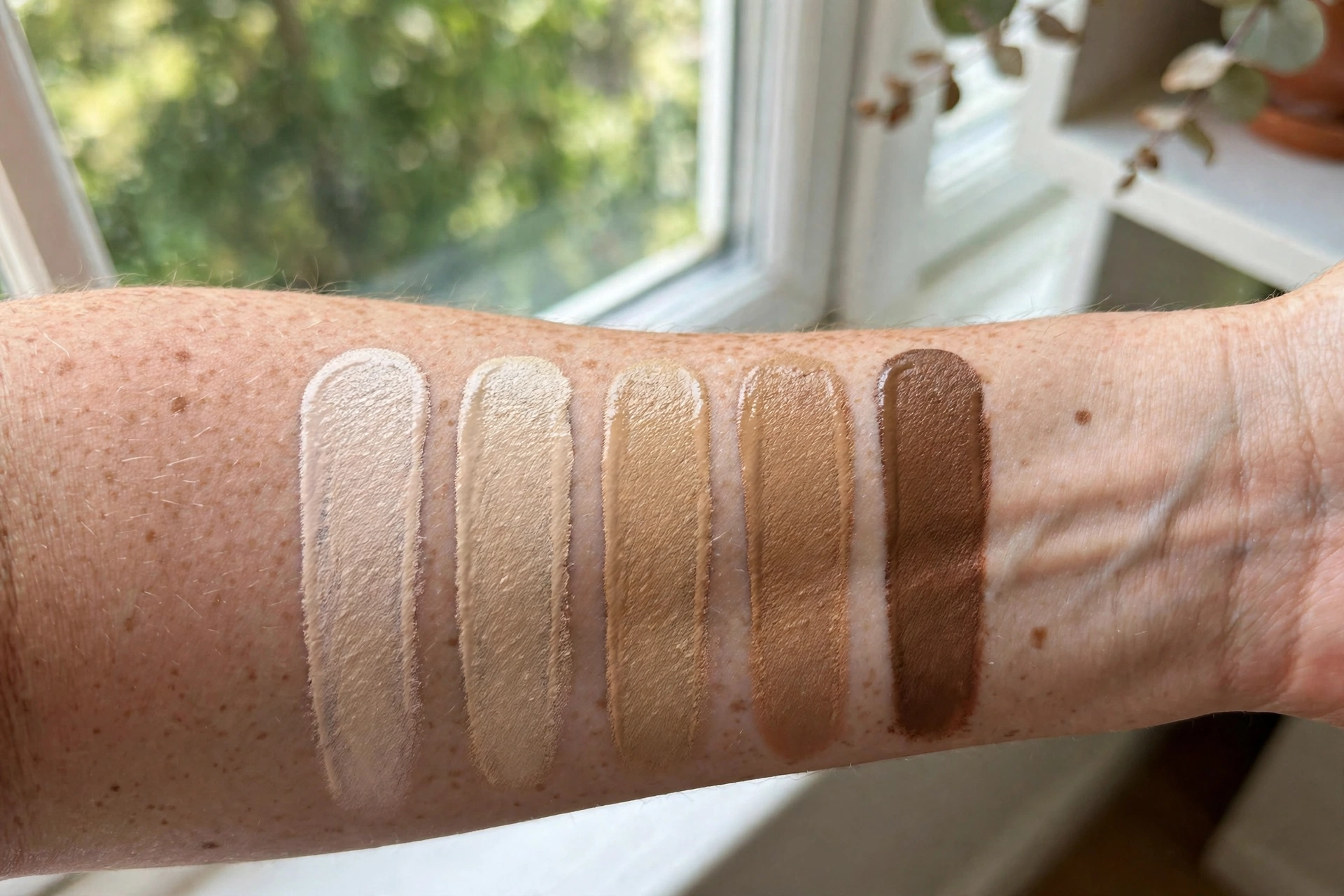
Matching foundation to your skin tone is the single most useful makeup skill you can learn. When the shade is right, your foundation disappears into your skin. When it is wrong, even an expensive foundation looks like a mask, with a visible line at your jaw and a colour that does not belong to your face.
This guide explains how to match foundation to your skin tone in the UK, step by step.
The short answer: find your undertone first, then your depth, then test on your jawline in daylight
Your skin tone has two parts. Depth is how light or dark your skin is. Undertone is the colour underneath, and it is warm, cool, neutral or olive. Most foundation mistakes are undertone mistakes, not depth mistakes. A foundation that is the right depth but the wrong undertone will look orange, pink or grey on your skin.
Depth and undertone: the two parts of your skin tone
Depth is the part of your skin tone you already know. It is whether your skin is fair, light, medium, tan or deep. Depth changes through the year. Most people in the UK are one shade lighter in winter and one shade darker in summer, because of the sun. Depth is also the part that shade names describe, with words such as fair, light, medium and deep.
Undertone is the part most people miss. It is the colour that shows through your skin from underneath, and it does not change with the seasons or with a tan. A warm undertone has a yellow or golden cast. A cool undertone has a pink or rosy cast. A neutral undertone has neither, or a mix of both. An olive undertone has a greenish cast, and it is the undertone most often missed, because it does not fit neatly into warm or cool.
| Undertone | What you see in your skin | Veins look | Jewellery that suits you | Foundation label to look for |
|---|---|---|---|---|
| Warm | A yellow or golden cast | Green | Gold | W, warm, yellow-based |
| Cool | A pink or rosy cast | Blue or purple | Silver | C, cool, pink-based |
| Neutral | Neither yellow nor pink stands out | Blue-green, hard to tell | Both gold and silver | N, neutral |
| Olive | A greenish or grey-green cast | Green, sometimes hard to see | Both, but gold often looks better | O, olive, or a warm shade with a green cast |
Test one: the vein test
The vein test is the quickest undertone test, and you can do it in a minute. Hold your wrist up in natural daylight, not under a yellow indoor light, and look at the veins on the inside of your wrist.
If your veins look green, you probably have a warm undertone. If your veins look blue or purple, you probably have a cool undertone. If your veins look blue-green, and you cannot decide whether they are blue or green, you probably have a neutral undertone. If your veins look green but your skin has a grey-green cast, you may have an olive undertone.
Test two: the jewellery test
The jewellery test uses the metal that looks best against your skin. Hold a gold necklace or earring against your skin, then hold a silver one in the same place, and look in a mirror in daylight.
If gold looks better, and your skin looks warm and healthy next to it, you probably have a warm undertone. If silver looks better, and your skin looks bright and clear next to it, you probably have a cool undertone. If both look good, and neither one makes your skin look dull, you probably have a neutral undertone.
Test three: the white paper test
The white paper test is the simplest of the three, and it is the most useful if you are not sure about the other two. Hold a plain white sheet of paper next to your face, in natural daylight, and look in a mirror.
If your skin looks yellow or golden next to the white paper, you probably have a warm undertone. If your skin looks pink or rosy next to the white paper, you probably have a cool undertone. If your skin looks grey or greenish next to the white paper, you may have an olive undertone. If your skin looks neither yellow nor pink, and it simply looks like your own skin, you probably have a neutral undertone.
Do this test with a clean face, with no makeup on, and in daylight near a window. Indoor light, especially warm yellow light, will change what you see. If you have redness on your cheeks, ignore the redness and look at the skin on your forehead and neck, where the undertone is easier to see.
Olive undertones: the undertone most people miss
Olive undertones are common in the UK, especially among people with Mediterranean, South Asian, Middle Eastern or mixed heritage, but they are the undertone most often missed, because most foundation ranges are built around warm and cool, and many brands do not offer an olive shade at all.
If you have an olive undertone, warm foundations will look too yellow or orange on you, and cool foundations will look too pink. Your skin may look grey or ashen in a foundation that is the right depth but the wrong undertone. You may also find that a foundation looks right in the shop but turns grey or muddy on your skin after an hour. These are all signs of an olive undertone.
To match an olive undertone, look for a foundation labelled olive, or a warm foundation with a green cast, and test it on your jawline. If you cannot find an olive shade in your depth, buy a warm shade and a cool shade and mix them, or add a drop of a green colour corrector to a warm foundation. A green corrector cancels the yellow and pink, and leaves a neutral, olive tone. Start with a tiny amount, because a little goes a long way.
How to test foundation on your jawline
Jawline testing is the only reliable way to check a foundation shade, because the jawline is where your face meets your neck, and a good match will blend into both. Never test foundation on the back of your hand, because the skin there is a different colour from your face, and a shade that looks right on your hand can look wrong on your face.
Choose three shades that are close to your skin: one that looks right, one a little lighter, and one a little darker. Apply a stripe of each one down your jawline, from your cheek to your neck, and blend the edges lightly. Do not blend them into each other. Leave them for ten minutes, then look in a mirror in natural daylight.
The right shade is the one that disappears into your skin. If you can see a line where the foundation ends, it is the wrong shade. If the stripe looks darker than your skin, it is too dark. If it looks lighter, it is too light. If the stripe looks orange, the undertone is too warm. If it looks pink, the undertone is too cool. If it looks grey, the undertone is wrong for you, and you may have an olive undertone.
Test in daylight, not under shop lights, because shop lights are often warm and yellow, and they make foundations look darker and warmer than they are. If you cannot get to a window, step outside the shop door for a minute and check the stripes in daylight. A shade that looks right in the shop can look wrong at home, so take the time to check it properly.
Mixing two shades to get your perfect match
Mixing two shades is the simplest way to get a perfect match when no single shade is right. It is also the best way to deal with a shade that is close but not quite right, or with a skin tone that changes through the year.
Buy the two shades closest to your skin, one a little lighter and one a little darker, in the same undertone. Mix them on the back of your hand, starting with equal parts, and test the mix on your jawline. If the mix is too light, add more of the darker shade. If it is too dark, add more of the lighter shade. Once you find the mix that disappears into your skin, remember the ratio, so you can repeat it.
You can also mix two undertones. If a warm shade looks too yellow and a cool shade looks too pink, mix them together and you will often get a neutral or olive tone that suits you. This is especially useful if you have an olive undertone and your brand does not offer an olive shade.
Winter and summer: how your shade changes
Your foundation shade changes through the year, because your skin changes. Most people in the UK are one shade lighter in winter and one shade darker in summer, because of the sun, even if they do not tan much. Your undertone does not change, but your depth does, so you need a lighter shade in winter and a darker shade in summer.
Keep two shades, one for winter and one for summer, in the same undertone. In spring and autumn, when your skin is between the two, mix them together to get the shade in between. This is cheaper than buying a new foundation every season, and it means you always have a match.
Do not wear your summer shade in winter, because it will look too dark and orange on pale winter skin. Do not wear your winter shade in summer, because it will look too light and ashy on tanned skin. Change your shade when your skin changes, not when the calendar changes. If you have been on holiday and your skin is darker, switch to the darker shade as soon as you come home.
Where to try shades, and what to buy first
The best place to try foundation shades in the UK is in store, at Boots or Superdrug, where you can use the testers and check the shade in daylight. Both shops stock a wide range of brands, and both will let you return a foundation if the shade is wrong, as long as you keep the receipt. Try the shade on your jawline, step outside to check it in daylight, and do not let a shop assistant rush you into buying.
If you already know your shade, buying online is quicker, and you can compare prices. But if you are trying a new brand or a new shade, buy in store, because the colour on a screen is never accurate. Our guide to the best drugstore foundations in the UK gives under-£15 picks for every skin type, so once you know your undertone and depth, you can choose a product with confidence.
| Situation | What to do |
|---|---|
| No single shade disappears on your jawline | Buy the two closest shades in the same undertone and mix them |
| The right depth looks orange | The undertone is too warm; try a cooler shade in the same depth |
| The right depth looks pink | The undertone is too cool; try a warmer shade in the same depth |
| The right depth looks grey or ashen | You may have an olive undertone; try an olive shade or mix warm and cool |
| Your shade is right in winter but wrong in summer | Keep a darker shade in the same undertone for summer, and mix in between |
| You cannot find your shade in one brand | Try another brand; shade ranges vary, and no brand suits everyone |
How to apply foundation once the shade matches
A good shade match will still look bad if you apply the foundation badly, so apply it in thin layers, starting in the centre of your face and blending outwards. Use a damp sponge for a natural finish, or a brush for more coverage. Build up coverage only where you need it, such as on redness or spots, and leave the rest of your skin sheer. Our everyday makeup routine for beginners covers skin prep and application in full, if you want a step by step guide.
Mistakes to avoid
- Testing on the back of your hand: the skin on your hand is a different colour from your face. Test on your jawline in daylight instead.
- Choosing by depth alone: a foundation that is the right depth but the wrong undertone will look orange, pink or grey. Find your undertone first.
- Testing under shop lights: shop lights are warm and yellow, and they make foundations look darker and warmer than they are. Check in daylight.
- Buying the shade you wish you were: a darker shade will not make you look tanned, it will make you look orange. Choose the shade that disappears into your skin.
- Ignoring the olive undertone: if warm looks orange and cool looks pink, you may have an olive undertone. Try an olive shade or mix warm and cool.
- Deciding too quickly: some foundations darken as they dry. Wait ten minutes before you judge a shade.
- Buying online without trying: screen colours are never accurate. Use a tester in store, or buy from a shop with a good returns policy.
Frequently asked questions
How do I know my undertone?
Use the three tests in this guide: the vein test, the jewellery test, and the white paper test. If two of the three agree, that is your undertone. Green veins and gold jewellery mean warm, blue veins and silver jewellery mean cool, and a greenish cast means olive.
Should I test foundation on my jawline or my cheek?
Test on your jawline, where your face meets your neck. The right shade disappears into both your face and your neck. Testing on your cheek alone can hide a mismatch, because your cheek may be redder or darker than the rest of your face.
What if I am between two shades?
Buy both shades in the same undertone and mix them. Start with equal parts, test the mix on your jawline, and adjust until it disappears. Mixing is also the best way to deal with a shade that changes between winter and summer.
What foundation shade suits olive skin?
Look for a foundation labelled olive, or a warm shade with a green cast. If your brand does not offer one, mix a warm shade and a cool shade together, or add a tiny drop of green colour corrector to a warm foundation. Warm alone will look orange, and cool alone will look pink.
Does my foundation shade change in summer?
Yes, for most people. Your skin is usually one shade darker in summer and one shade lighter in winter, because of the sun. Your undertone does not change, so buy the same undertone in a darker depth for summer, and mix the two shades in spring and autumn.
Why does my foundation look orange on me?
It is usually an undertone mistake. A warm foundation on cool or olive skin looks orange. Try a cooler shade in the same depth, or a neutral shade, and test it on your jawline in daylight. It can also happen if the shade is too dark for you, or if the foundation oxidises and darkens as it dries.
Conclusion
Matching foundation to your skin tone comes down to two things: your undertone and your depth. Find your undertone with the vein, jewellery and white paper tests. Choose a foundation in your depth with that undertone. Test three stripes on your jawline in daylight, wait ten minutes, and choose the one that disappears. If no single shade is right, mix two shades, and keep a lighter one for winter and a darker one for summer. With the right undertone and the right depth, your foundation will look like your skin, only better.