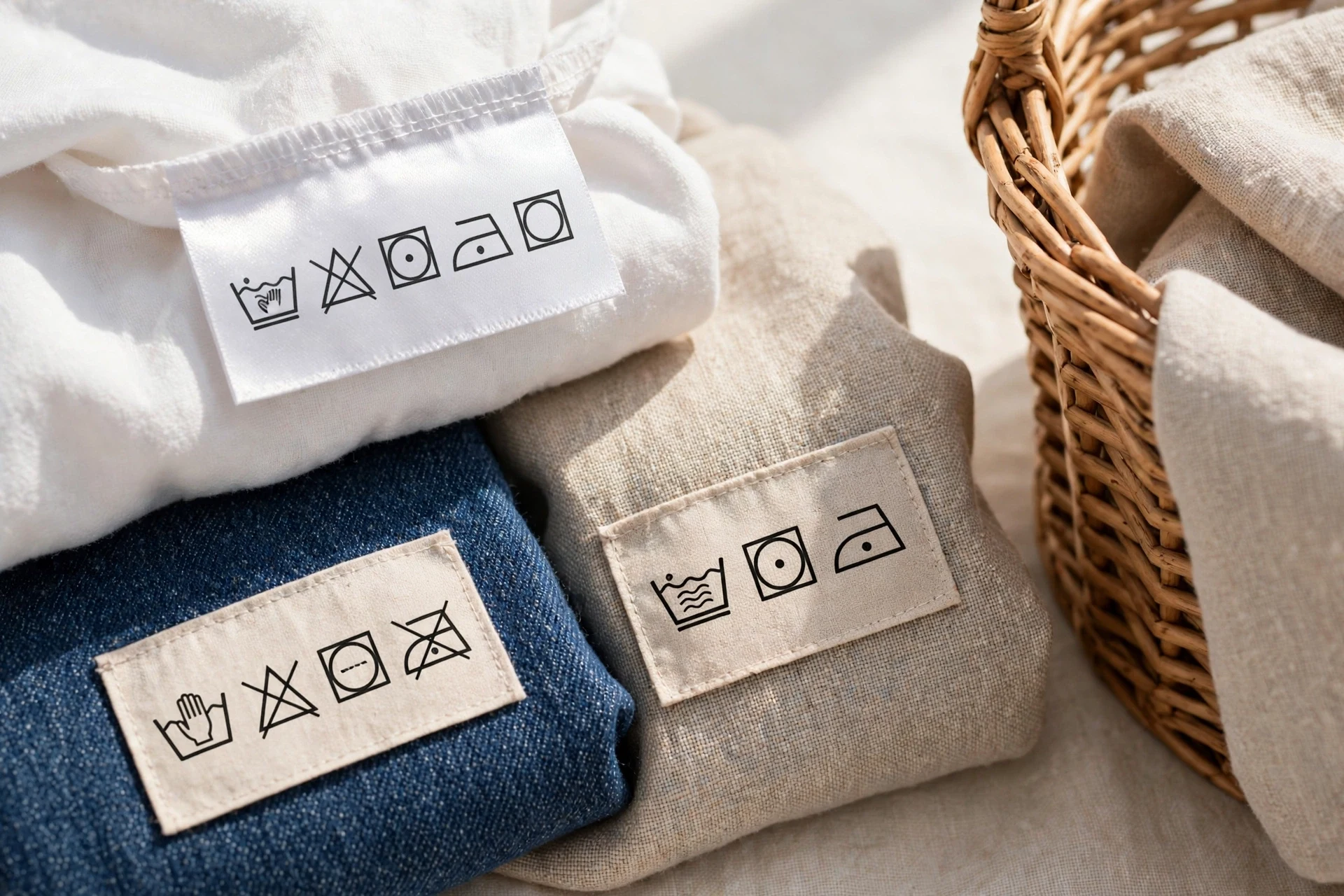
Washing symbols are the small pictures printed on clothing care labels. They tell you how to wash, dry, bleach and iron each garment. Once you know what each symbol means, you can read any label in seconds and stop shrinking, fading or damaging your clothes.
This is washing symbols explained in plain English. It covers the five symbol families, the temperature dots, the bars underneath symbols and the crossed out versions. It also shows you how to read a real label step by step and lists the common mistakes that ruin clothes.
What Are Washing Symbols?
Washing symbols are a set of standard pictograms sewn into garments on a care label. Clothing makers use them to give care instructions without words. The same symbols appear on labels across the UK and Europe, so one you learn works on almost every garment you buy.
The system groups symbols into five families, each with its own basic shape. The wash symbol is a tub of water, the bleach symbol is a triangle, the drying symbol is a square, the ironing symbol is an iron and the dry cleaning symbol is a circle. Extra marks change the meaning. Dots show temperature, bars underneath show how gentle the cycle must be and a cross means you must not do that action.
Care labels are usually found at a side seam or at the back of the neck. Some labels also include written instructions and fabric details, with the symbols first. If a symbol and a written note seem to disagree, follow the stricter instruction.
How to Read a Care Label Step by Step
Reading a care label takes less than a minute once you know the order. Follow these five steps every time you wash a new garment.
- Find the label. Look at the left side seam or the back of the neck for a small white or cream tag.
- Read the symbols from left to right. Labels usually show wash first, then bleach, drying, ironing and dry cleaning. Read them in that order.
- Check the dots and bars. Dots inside a symbol show the temperature, and bars under a symbol show how gentle the treatment must be. One bar means a gentler cycle and two bars mean the gentlest cycle.
- Look for crosses. A symbol with a cross through it is a ban. A crossed out iron means do not iron and a crossed out tub means do not wash.
- Check the fabric and written notes. The label may name the fabric, such as wool or silk, and written notes add detail, such as wash with similar colours or reshape while damp.
If a garment has no label, treat it gently. Wash it on a cool cycle, dry it flat away from direct heat and test a hidden area before ironing. A missing label is common on vintage pieces, and our guide to timeless vintage clothing explains why older garments need extra care.
Wash Symbols Explained
The wash symbol is a tub filled with water. It tells you whether a garment can go in a washing machine and which cycle and temperature to use. The number inside the tub is the maximum water temperature in degrees Celsius, and dots work the same way. More dots mean hotter water.
Most UK labels use numbers rather than dots, but both systems mean the same thing. A tub with 30 means wash at 30 degrees or cooler, and a tub with one dot means the same. Two dots mean 40 degrees, three dots 50, four dots 60, five dots 70 and six dots 95.
| Symbol | Meaning | What to do |
|---|---|---|
| Tub with water | Machine washable | Wash in the machine on a normal cycle |
| Tub with a number, such as 30 or 40 | Maximum wash temperature | Do not wash hotter than the number shown |
| Tub with dots | Temperature by dots | One dot is 30 degrees, two dots 40, three dots 50, four dots 60, five dots 70, six dots 95 |
| Tub with one bar underneath | Permanent press cycle | Use a gentler cycle with a reduced spin |
| Tub with two bars underneath | Delicate or gentle cycle | Use the gentlest cycle and a low spin speed |
| Tub with a hand above it | Hand wash only | Wash by hand in cool water and do not wring the garment |
| Tub with a cross through it | Do not wash | Do not put the garment in water. Take it to a dry cleaner |
Cold water is the safest choice for most everyday clothes. It protects colours and saves energy. Hot water suits bedding, towels and heavily soiled items, but only when the label allows it. Wool, silk and many synthetics shrink or lose shape in hot water.
Hand wash symbols appear on delicate items such as silk blouses, fine knitwear and garments with beading. Fill a basin with cool water and a small amount of gentle detergent, soak the item briefly and press the water out gently. Never wring a hand wash garment, as wringing twists the fibres and can stretch the shape permanently.
Bleach Symbols Explained
The bleach symbol is a triangle. It tells you whether you can use bleach on a garment and which type is safe. Bleach is a strong chemical, and the wrong type can strip colour, weaken fibres and leave yellow marks, so check this symbol before you add anything to a wash.
An empty triangle means any bleach is safe, including chlorine bleach. A triangle with two diagonal lines inside means you can use non-chlorine bleach, also called oxygen bleach. A triangle with a cross through it means do not use any bleach at all.
| Symbol | Meaning | What to do |
|---|---|---|
| Empty triangle | Any bleach allowed | You can use chlorine or oxygen bleach if needed |
| Triangle with two diagonal lines | Non-chlorine bleach only | Use oxygen bleach only. Do not use chlorine bleach |
| Triangle with a cross through it | Do not bleach | Do not add any bleach. Use a colour safe stain remover instead |
Oxygen bleach is gentler than chlorine bleach and is safe on many colours. It works well on grey looking whites and stained cottons. Always follow the dose on the product pack and never mix bleach with other cleaning products.
Drying Symbols Explained
The drying symbol is a square. It covers both tumble drying and natural drying. A square with a circle inside it is a tumble dryer symbol, while a plain square with lines or curves inside it describes natural drying, such as line drying or drying flat.
Tumble dryer symbols use dots for heat, just like wash symbols. One dot means low heat, two dots medium heat and three dots high heat. A square with a circle and a cross through it means do not tumble dry. Many garments carry this mark, including wool jumpers, silk and clothes with prints or elastic.
| Symbol | Meaning | What to do |
|---|---|---|
| Square with a circle, one dot | Tumble dry on low heat | Dry on the lowest heat setting |
| Square with a circle, two dots | Tumble dry on medium heat | Dry on a medium heat setting |
| Square with a circle, three dots | Tumble dry on high heat | Dry on a high heat setting |
| Square with a circle and a cross | Do not tumble dry | Dry naturally instead of using a dryer |
| Square with a curved line at the top | Line dry | Hang the garment on a washing line |
| Square with two diagonal lines in the corner | Dry in the shade | Dry away from direct sunlight to protect the colour |
| Square with one horizontal line | Dry flat | Lay the garment flat on a towel so it keeps its shape |
| Square with three vertical lines | Drip dry | Hang the garment while wet and let it drip dry |
Line drying is the kindest option for most clothes. It uses no heat and helps clothes last longer. Dry coloured items in the shade when the label asks for it, as sunlight fades dark colours quickly. Rotating clothes also spreads the wear, and our capsule wardrobe by season guide shows how to do it.
Ironing Symbols Explained
The ironing symbol is shaped like an iron. It tells you whether you can iron a garment and how hot the iron can be. Dots inside the iron show the temperature. One dot means a cool iron at around 110 degrees, two dots a medium iron at around 150 degrees and three dots a hot iron at around 200 degrees.
A crossed out iron means do not iron the garment. This mark appears on fabrics that melt or mark easily, such as nylon, sequinned items and some prints. If you must remove creases from a no iron garment, hang it in a steamy bathroom first. Steam relaxes many fabrics without direct heat.
| Symbol | Meaning | What to do |
|---|---|---|
| Iron with one dot | Cool iron, up to 110 degrees | Iron on the lowest setting. Suits silk, nylon and acetate |
| Iron with two dots | Medium iron, up to 150 degrees | Iron on a medium setting. Suits polyester, wool and blends |
| Iron with three dots | Hot iron, up to 200 degrees | Iron on a high setting. Suits cotton and linen |
| Iron with a cross through it | Do not iron | Do not use an iron. Try steam from a distance instead |
| Iron with steam lines crossed out | Do not steam | Iron dry only, without steam |
Always iron printed or embellished garments on the reverse side, as direct heat can melt prints and damage sequins. Use a pressing cloth for delicate fabrics. A clean cotton cloth between the iron and the garment spreads the heat and stops shine marks.
Dry Cleaning Symbols Explained
The dry cleaning symbol is a circle. It tells you whether a garment needs professional cleaning and which solvent the cleaner should use. The letters inside the circle matter to the dry cleaner, even if most people only need to know the plain circle and the crossed out circle.
An empty circle means the garment can be dry cleaned. A circle with the letter P means any solvent except trichloroethylene. A circle with the letter F means petroleum solvent only. A circle with the letter A means any solvent. A circle with a cross through it means do not dry clean.
| Symbol | Meaning | What to do |
|---|---|---|
| Empty circle | Dry clean only | Take the garment to a professional dry cleaner |
| Circle with the letter P | Dry clean with any solvent except trichloroethylene | Tell the cleaner if the label shows this letter |
| Circle with the letter F | Dry clean with petroleum solvent only | Use a cleaner that offers petroleum solvent cleaning |
| Circle with the letter A | Dry clean with any solvent | Any professional dry cleaning method is safe |
| Circle with the letter W | Professional wet clean | The garment needs a professional water based clean |
| Circle with a cross through it | Do not dry clean | Do not take it to a dry cleaner. Wash it at home if the wash symbol allows |
Dry clean only appears on structured garments such as tailored jackets, lined coats and some silk dresses. Home washing can shrink the lining or distort the shape. Professional cleaning costs more, but it protects garments that would be expensive to replace.
What the Dots, Bars and Crosses Mean
Three small marks change the meaning of every care symbol. Once you understand them, you can read any label even if you do not recognise the base shape.
Temperature Dots
Dots show heat. They appear inside wash tubs, tumble dryer squares and irons. One dot always means the coolest setting and more dots mean more heat. The scale is the same across symbol families, which makes it easy to remember. One dot on a wash tub means 30 degrees and one dot on an iron means a cool iron at about 110 degrees. The exact temperatures differ by family, but fewer dots always mean gentler heat.
Bars Under Symbols
Bars under a symbol show how gentle the treatment must be. No bar means a normal cycle, one bar a gentler cycle with a reduced spin and two bars the gentlest cycle with a very low spin. Bars appear most often under wash tubs, but they can appear under other symbols too.
Bars protect fabrics that crease, stretch or snag easily. A permanent press cycle with one bar suits shirts and trousers that crease. A delicate cycle with two bars suits fine knits, lace and garments with trims. A normal cycle on a two bar garment can shrink it or damage the finish.
Crossed Out Symbols
A cross through a symbol is a ban. It tells you not to do that action under any circumstances. A crossed out tub means do not wash in water, a crossed out triangle means do not use bleach, a crossed out iron means do not iron and a crossed out circle means do not dry clean.
Crossed out symbols are the most important marks on a label, and ignoring one is the fastest way to ruin a garment. A crossed out tub usually means the item must go to a dry cleaner, and a crossed out dryer means it will shrink or melt in a tumble dryer. Always scan for crosses before you start a wash.
Common Mistakes That Ruin Clothes
Most laundry damage comes from a few repeated mistakes. Avoid these and your clothes will last much longer.
- Washing everything at 40 degrees. Many garments need 30 degrees or a hand wash, and hot water shrinks wool, fades colour and weakens elastic. Check the tub symbol every time.
- Ignoring the bars. A two bar delicate symbol means the gentlest cycle. A normal cycle can twist knitwear and damage trims.
- Tumble drying everything. Heat is the main cause of shrinkage. If the square has a cross through it, line dry or dry flat instead.
- Using chlorine bleach on colours. Chlorine bleach strips colour in minutes. Only use it when the triangle is empty.
- Ironing on the wrong heat. A hot iron melts nylon and scorches silk. Match the dots on the iron symbol to your iron setting.
- Overloading the machine. Clothes need room to move, and an overloaded drum cleans badly and creases everything.
- Skipping the label on new clothes. New garments often have different care needs from old ones. Read the label before the first wash, not after the damage is done.
- Drying dark clothes in bright sun. Sunlight fades dark colours fast. Dry dark items in the shade when the label shows the shade symbol.
Static is another common laundry problem, especially in winter when heating dries the air. Our guide on how to get rid of static in clothes explains simple ways to stop clothes clinging.
Smells can linger even after a wash, particularly on gym clothes and vintage finds. If a garment still smells after washing, read our guide on getting smells out of clothes for natural solutions.
Frequently Asked Questions
What do the washing symbols on clothes mean?
Washing symbols are standard pictures on care labels that explain how to wash, dry, bleach and iron a garment. The tub means wash, the triangle bleach, the square dry, the iron iron and the circle dry clean. Dots show temperature, bars show how gentle the cycle must be and a cross means do not do that action.
What does the tub symbol with 30 mean?
A tub with 30 means wash the garment in water at 30 degrees Celsius or cooler. It is the most common temperature on UK labels, and it suits everyday clothes, colours and mixed fabrics. It protects colours and saves energy, and most modern detergents work well at 30 degrees.
What does a triangle with a cross mean on a care label?
A triangle with a cross means do not use any bleach on the garment. It appears on most coloured clothes and delicate fabrics, as bleach would strip the colour or damage the fibres. Use a colour safe stain remover instead if the garment is stained.
What does dry clean only mean?
Dry clean only means the garment must be cleaned by a professional dry cleaner using solvents instead of water. It appears on structured items such as tailored jackets and lined coats, and washing them at home can shrink the lining or distort the shape.
Can I tumble dry clothes if the label says do not tumble dry?
No. A square with a circle and a cross means the garment will shrink, melt or lose its shape in a tumble dryer. Dry it naturally instead, by line drying, drying flat or drip drying, depending on the other symbols on the label.
What do the dots on an iron symbol mean?
Dots on an iron symbol show the maximum iron temperature. One dot means a cool iron up to about 110 degrees, for silk and nylon. Two dots mean a medium iron up to about 150 degrees, for wool and polyester. Three dots mean a hot iron up to about 200 degrees, for cotton and linen. A crossed out iron means do not iron at all.
Conclusion
Washing symbols look confusing at first, but they follow a simple system, and this guide has washing symbols explained in full. Five shapes cover washing, bleaching, drying, ironing and dry cleaning. Dots set the temperature, bars set the gentleness and a cross bans the action. Learn those rules and you can read any care label in seconds.
Make it a habit to check the label before the first wash of every new garment. That one small step protects your clothes, saves money on replacements and keeps your wardrobe looking good for longer. For more wardrobe care ideas, see our spring wardrobe essentials guide and our fair trade sustainable clothing guide, which explains how caring for clothes is part of shopping more sustainably.