
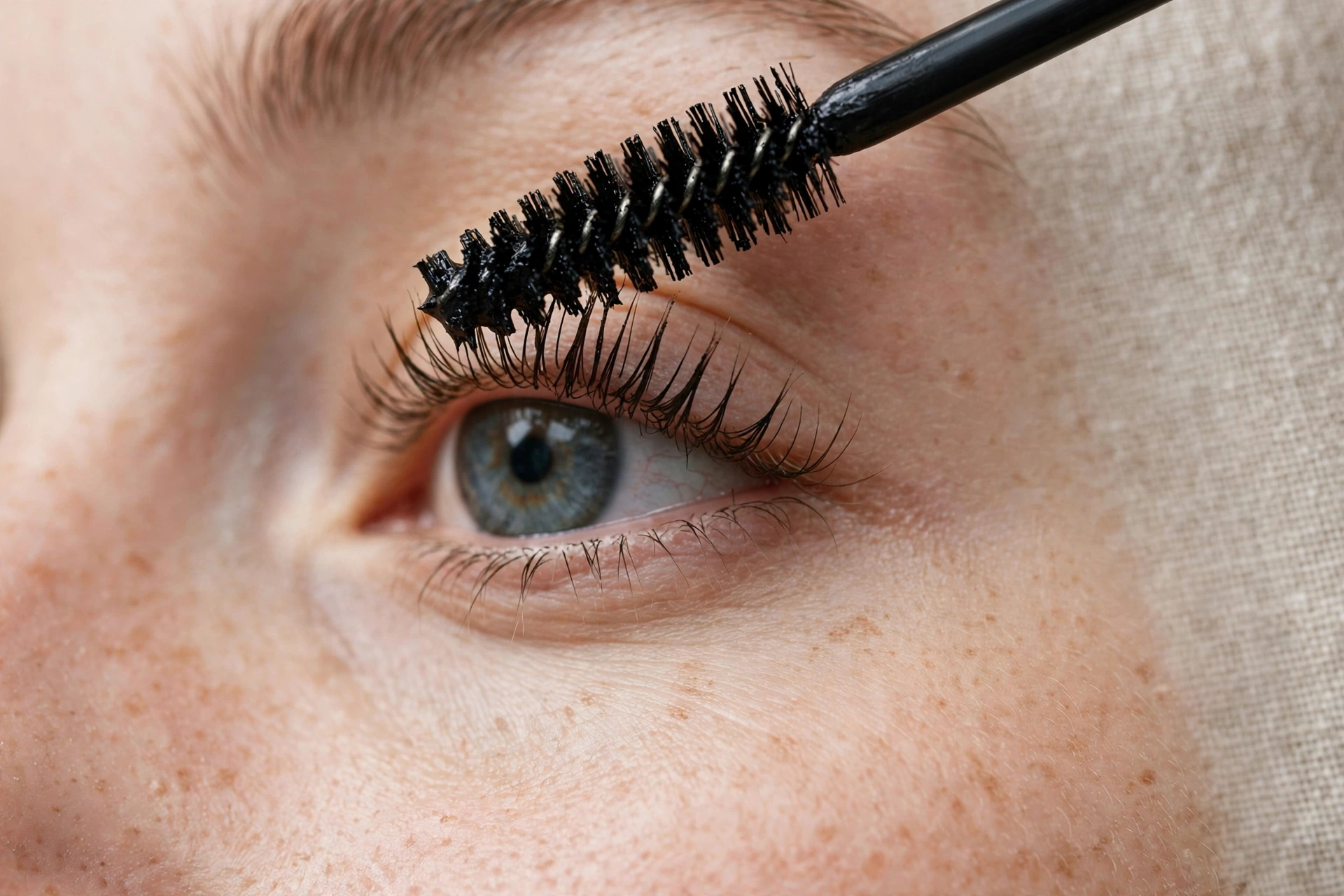
If your eyes water, itch or go red every time you wear mascara, the problem is usually the formula, not your eyes. Many mascaras contain fragrance, fibres and harsh waxes that irritate sensitive eyes, and a waterproof formula can make it worse, because it is harder to remove and you end up rubbing your eyes to get it off.
The short answer: choose a fragrance-free tubing mascara, and replace it every three months
The best mascara for sensitive eyes is a fragrance-free formula that is ophthalmologist tested, with no added fibres, and ideally a tubing formula that comes off with warm water. A tubing mascara is the safest choice for sensitive eyes, because it does not smudge, it does not flake into your eyes, and you never need to rub to remove it.
If you wear contact lenses, choose a mascara that is labelled safe for contact lens wearers, and avoid fibre mascaras, because the fibres can get under a lens.
If your eyes stay red, sore or watery after you switch to a gentle mascara, stop wearing mascara for a few days and speak to a pharmacist, your GP or your optician. This guide gives general advice only, and it cannot diagnose an eye problem.
Why mascara irritates sensitive eyes
Fragrance is the most common irritant in mascara. Many mascaras contain added fragrance to cover the smell of the waxes and oils, and sensitive eyes react to it quickly. Fibres are another common cause. Fibre mascaras add tiny fibres to the formula to make lashes look longer, but those fibres can fall into your eyes during the day, and they are very uncomfortable if you wear contact lenses.
Old mascara is the third cause, and it is the one most people miss. Mascara is a wet product, and once it is opened, bacteria grow in the tube. After about three months, the formula is no longer fresh, and it can irritate your eyes even if it smells normal. Pumping the wand in and out of the tube pushes air and bacteria in, which makes it worse. Twist the wand out slowly instead, and never share your mascara with anyone else.
What to look for on the label
Start with the words on the tube. Look for fragrance-free, hypoallergenic, ophthalmologist tested, and safe for contact lens wearers. Fragrance-free means no added fragrance, which is the single most useful thing for sensitive eyes. Hypoallergenic means the formula is made to be less likely to cause an allergic reaction, although it does not guarantee that no one will react. Ophthalmologist tested means the product has been tested under the supervision of an eye specialist, which is a good sign for sensitive eyes.
Look for a short ingredient list. A simple formula with fewer ingredients is less likely to contain something your eyes react to. Avoid mascaras that list fragrance or parfum near the top of the ingredient list, and avoid fibre mascaras if your eyes are sensitive or you wear contact lenses. A clean, simple formula is usually safer than one with a long list of active ingredients and added scents.
| Label or feature | What it means | Good for sensitive eyes? |
|---|---|---|
| Fragrance-free | No added fragrance in the formula | Yes, the single most useful feature |
| Ophthalmologist tested | Tested under an eye specialist’s supervision | Yes, a good sign |
| Hypoallergenic | Made to be less likely to cause a reaction | Yes, but not a guarantee |
| Safe for contact lens wearers | Tested with contact lenses in mind | Yes, essential if you wear lenses |
| Tubing | Forms tubes around each lash, removes with warm water | Yes, the gentlest removal |
| Fibre | Contains tiny fibres for length | No, fibres can fall into your eyes |
| Waterproof | Resists water, needs rubbing or oil to remove | Usually no, removal irritates eyes |
| Fragrance or parfum | Added scent in the formula | No, the most common irritant |
Tubing mascaras: the gentlest choice for sensitive eyes
A tubing mascara is the best choice for most people with sensitive eyes, and it is worth understanding what it is. A normal mascara paints a layer of pigment onto your lashes. A tubing mascara wraps each lash in a tiny polymer tube. The tubes do not smudge, they do not flake, and they do not run if your eyes water. At night, the tubes slide off with warm water, with no rubbing and no makeup remover needed.
To remove a tubing mascara, splash your face with warm water, hold a warm, damp cloth against your lashes for a few seconds, and gently slide the tubes off with your fingers. You will see the little tubes on your fingers or on the cloth. That is normal, and it is the mascara coming off cleanly, not your lashes falling out. If you rub, you will pull at your lashes, so be gentle.
Blinc Original Tubing Mascara is the best known tubing mascara in the UK, and it is a good place to start if you have sensitive eyes. It is fragrance-free, it does not smudge, and it comes off with warm water alone. Clinique Lash Power is another tubing mascara, and it is ophthalmologist tested and labelled safe for contact lens wearers. Both are premium priced, but a tube lasts for months, and the gentle removal is worth it if your eyes are sensitive.
Best budget picks for sensitive eyes
You do not need to spend a lot to get a gentle mascara. The UK high street has good budget options, and they are sold at Boots and Superdrug, where you can check the label before you buy.
Rimmel Kind and Free Mascara is a good budget pick for sensitive eyes. It is part of a range made without added fragrance, and it gives a natural, lengthened look without fibres. It is widely available on the high street, and it is one of the cheapest gentle mascaras you can buy. Apply one coat for a natural look, and two coats if you want more definition.
Maybelline Lash Sensational Sky High is a good budget pick if you want length and lift. It is not marketed specifically for sensitive eyes, so check the label and patch test it first, but many people with sensitive eyes find it comfortable, because the formula is light and the brush is slim and easy to control. If your eyes react to it, stop using it and try a fragrance-free option instead.
Best premium picks for sensitive eyes
If your eyes are very sensitive, or you wear contact lenses every day, a premium mascara is often worth the extra cost, because the formulas are more carefully tested and the ingredient lists are simpler.
Clinique High Impact Mascara is the most reliable premium pick for sensitive eyes. It is fragrance-free, ophthalmologist tested, and labelled safe for contact lens wearers. It gives length and definition without fibres, and it is one of the most widely recommended mascaras for sensitive eyes in the UK. It is a good choice if you have tried budget mascaras and they all irritated your eyes.
La Roche-Posay Respectissime Mascara is another premium pick, made for sensitive eyes and contact lens wearers. It is hypoallergenic and fragrance-free, and it is designed to be gentle on eyes that react easily. It gives a natural, soft look rather than dramatic volume, which suits people who want their eyes to look defined without feeling irritated.
| Mascara | Type | Best for | Key features |
|---|---|---|---|
| Rimmel Kind and Free | Washable, budget | Sensitive eyes on a budget | No added fragrance, natural finish |
| Maybelline Lash Sensational Sky High | Washable, budget | Length and lift | Light formula, slim brush, patch test first |
| Blinc Original Tubing | Tubing, premium | Smudge-free wear, gentle removal | Fragrance-free, removes with warm water |
| Clinique High Impact | Washable, premium | Very sensitive eyes, contact lenses | Fragrance-free, ophthalmologist tested |
| La Roche-Posay Respectissime | Washable, premium | Very sensitive eyes, contact lenses | Hypoallergenic, fragrance-free |
| Clinique Lash Power | Tubing, premium | Sensitive eyes, contact lenses | Tubing, ophthalmologist tested |
Best mascaras for contact lens wearers
If you wear contact lenses, your mascara needs to be even gentler, because anything that flakes into your eye can get trapped under a lens and cause pain and redness. Choose a mascara that is labelled safe for contact lens wearers, and avoid fibre mascaras completely, because the fibres are the most likely thing to get under a lens.
Put your contact lenses in before you apply mascara, not after, so you do not push mascara onto the lens with your fingers. Apply the mascara with a light hand, and do not coat the roots of your lower lashes heavily, because that is where flakes fall from. Let the mascara dry fully before you blink hard or rub your eyes.
What to avoid if your eyes are sensitive
Avoid fragrance first. If a mascara lists fragrance or parfum in its ingredients, do not buy it, however good the reviews are. Fragrance is the most common cause of eye irritation from mascara, and it is easy to avoid by reading the label.
Avoid fibre mascaras. The fibres make lashes look longer, but they fall into your eyes during the day, and they are very uncomfortable, especially if you wear contact lenses. If a mascara promises extreme length from fibres, it is not the right choice for sensitive eyes.
Avoid waterproof mascara for everyday wear. It is useful for swimming or a wedding, but for daily wear it is harder to remove, and the rubbing needed to remove it irritates sensitive eyes. Use a washable or tubing mascara for everyday wear, and save waterproof for the occasions when you really need it.
How to apply mascara without irritating your eyes
Apply mascara to clean lashes, with no leftover mascara from the day before. Start at the roots and wiggle the brush gently up to the tips, in one smooth movement. Do not pump the wand in and out of the tube, because that pushes air and bacteria in. Twist the wand out slowly, wipe off any excess on the rim of the tube, and apply one thin coat.
Use a lash curler before mascara, not after, because curling lashes that are already coated can pull them out. Do not use a heated curler if your eyes are sensitive, because the heat can irritate them. Our everyday makeup routine for beginners covers mascara application as part of a full routine, if you want a step by step guide.
How to remove mascara gently
Removing mascara gently matters as much as choosing the right formula, because rubbing is what irritates sensitive eyes most. Never rub your eyes to remove mascara, and never pull at your lashes to get the last bits off.
If you wear a tubing mascara, splash your face with warm water and hold a warm, damp cloth against your lashes for a few seconds, then slide the tubes off gently with your fingers. If you wear a washable mascara, use a gentle makeup remover or a cleansing balm, and hold a damp cotton pad against your closed eye for ten seconds before you wipe, so the formula dissolves before you move the pad. Our guide to how to remove makeup properly explains the double cleanse method in full, which is the gentlest way to remove eye makeup without rubbing.
When to replace your mascara
Replace your mascara every three months, from the day you first open it. Write the date on the tube with a marker when you open it, so you know when three months is up. After three months, throw the tube away, even if it still looks and smells fine, because bacteria have had time to grow in it.
Replace it sooner if it smells odd, if the texture has gone dry or clumpy, if it does not coat your lashes evenly any more, or if your eyes start to feel irritated when you wear it. If you have had an eye infection, throw your mascara away straight away and buy a new one, because the old tube can carry the infection back to your eyes.
Mistakes to avoid
- Choosing a fragranced mascara: fragrance is the most common irritant. Choose a fragrance-free formula and read the ingredient list.
- Using a fibre mascara: the fibres fall into your eyes and under contact lenses. Choose a tubing or fibre-free formula instead.
- Wearing waterproof mascara every day: it is hard to remove, and the rubbing irritates your eyes. Save it for swimming or special occasions.
- Keeping mascara for too long: replace it every three months, and sooner if it smells odd or your eyes feel irritated.
- Pumping the wand: it pushes air and bacteria into the tube. Twist the wand out slowly instead.
- Applying mascara to the waterline: it puts the formula directly against your eye. Apply it to the lashes only.
- Rubbing your eyes to remove mascara: it irritates the delicate skin and pushes residue into your eyes. Hold a warm cloth or a damp cotton pad against your closed eye first, then wipe gently.
- Sharing mascara: it spreads bacteria and eye infections. Never share mascara, even with family.
Frequently asked questions
What is the best mascara for sensitive eyes?
A fragrance-free, ophthalmologist tested mascara with no fibres, ideally a tubing formula. Clinique High Impact and La Roche-Posay Respectissime are the most reliable premium picks, and Rimmel Kind and Free is the best budget pick. A tubing mascara such as Blinc or Clinique Lash Power is the gentlest choice, because it comes off with warm water and does not flake.
Can I wear mascara with contact lenses?
Yes, if you choose a mascara labelled safe for contact lens wearers and avoid fibre mascaras. Put your lenses in before you apply mascara, and remove the mascara gently at night. Clinique High Impact and La Roche-Posay Respectissime are both labelled safe for contact lens wearers.
Are tubing mascaras better for sensitive eyes?
Yes, for most people. A tubing mascara wraps each lash in a tiny tube that does not smudge or flake, and it slides off with warm water, so you never need to rub your eyes to remove it. It is the gentlest removal of any mascara type, and it is a good choice if your eyes water easily.
Why do my eyes water when I wear mascara?
It is usually the formula, especially fragrance or fibres, or the mascara is old. Try a fragrance-free, fibre-free mascara, replace it if it is more than three months old, and stop wearing mascara for a few days if your eyes stay sore. If the watering continues, speak to a pharmacist, your GP or your optician.
How often should I replace mascara?
Every three months from the day you open it, even if you only use it occasionally. Replace it sooner if it smells odd, goes dry or clumpy, or irritates your eyes. If you have had an eye infection, throw it away straight away and buy a new one.
Is waterproof mascara bad for sensitive eyes?
It is not the formula itself, but the removal. Waterproof mascara needs rubbing or oil to remove, and rubbing irritates sensitive eyes. Use a washable or tubing mascara for everyday wear, and save waterproof for swimming or special occasions when you really need it.
Conclusion
The best mascara for sensitive eyes is a fragrance-free, ophthalmologist tested formula with no fibres, and a tubing mascara is the gentlest choice of all, because it comes off with warm water and never needs rubbing. Choose a mascara labelled safe for contact lens wearers if you wear lenses, apply one thin coat and let it dry, remove it gently at night, and replace it every three months. With the right formula and a gentle routine, you can wear mascara every day without sore, watery eyes.