
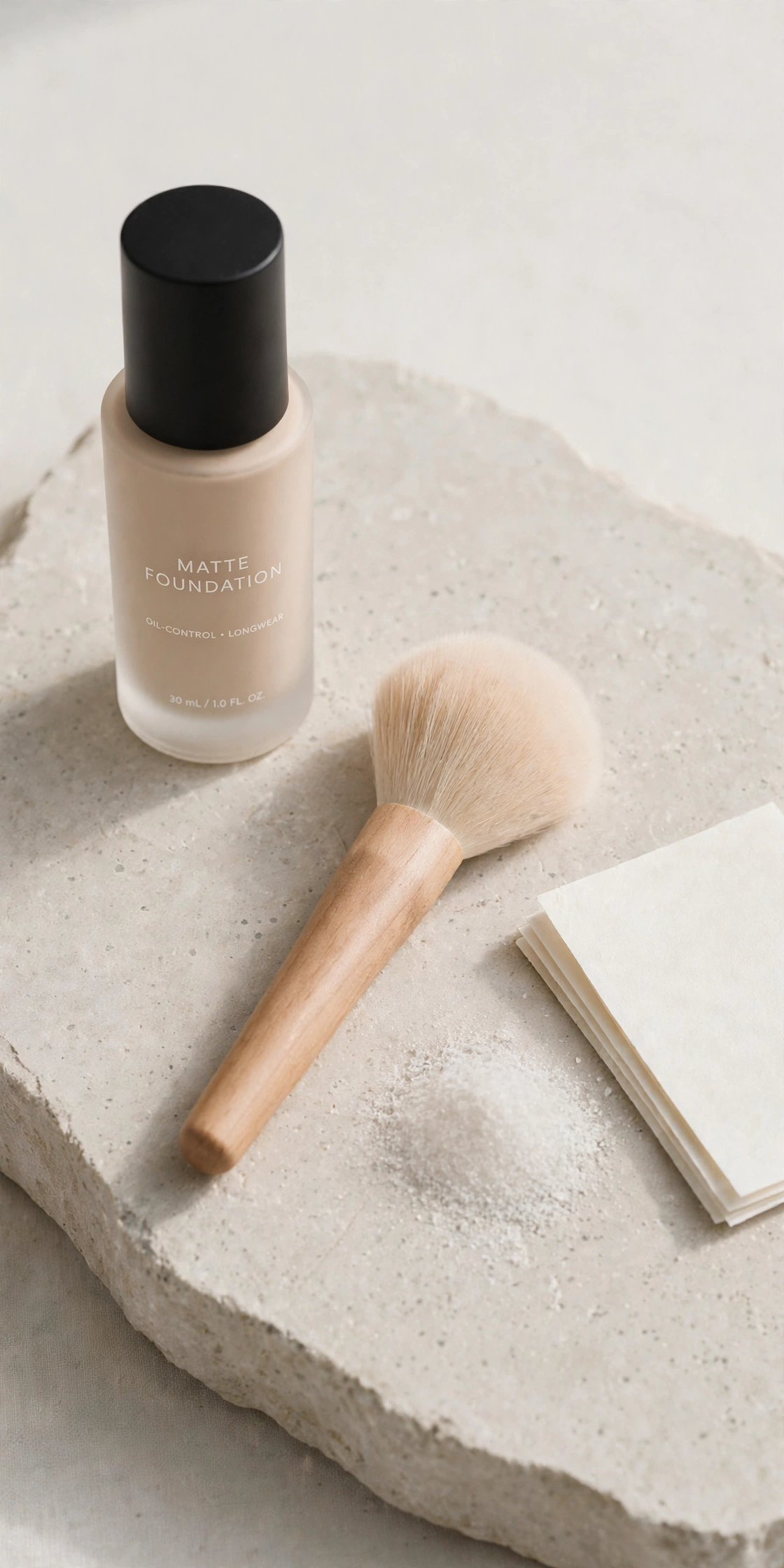
The best foundation for oily skin is an oil-free, matte foundation with long wear, applied over a mattifying primer and set with a translucent powder. It controls shine for hours without looking flat, and it does not slide off by the afternoon. Start with a budget high-street pick, learn the priming and setting steps below, and buy a premium foundation only if you want a wider shade range or a longer wear time.
The short answer: oil-free, matte, and a mattifying primer
Choose an oil-free foundation with a matte or natural matte finish. Oil-free means the formula does not add extra oil to skin that already makes plenty of its own. A matte finish controls shine, and a long wear formula stays put through a long day, even in warm weather.
Apply a mattifying primer on the T-zone first, where shine shows first. A primer fills in pores, smooths the skin, and gives the foundation something to hold on to. Then apply a thin layer of foundation, blend it well, and set it with a translucent powder on the T-zone. That is the whole routine, and it is what keeps oily skin matte for hours.
Do not buy a dewy or radiant foundation for oily skin. A dewy finish adds shine to skin that already shines, and it breaks up faster. If you like a natural finish, choose a natural matte finish, not a dewy one. It gives you a skin-like look without the shine.
What makes a foundation good for oily skin
A good foundation for oily skin does three things: it controls shine, it stays put, and it does not clog pores. Shine control comes from a matte finish and an oil-free formula. Staying power comes from a long wear formula that resists sweat and oil. A non-comedogenic formula is less likely to clog pores, which matters for oily skin, because oily skin is more prone to breakouts.
Look for words such as matte, oil-free, long wear and non-comedogenic on the bottle. These words tell you what the formula is made to do. Avoid words such as dewy, radiant, hydrating and luminous, which tell you the formula adds glow and moisture, which oily skin does not need.
Coverage matters less than finish for oily skin. A medium coverage foundation with a matte finish will look better on oily skin than a full coverage foundation with a dewy finish, because the matte finish controls shine and the medium coverage looks more natural. If you need more coverage, build it up in thin layers, rather than applying one thick layer, which is more likely to slide off.
Oil-free vs powder vs silicone bases
Foundations for oily skin come in three main bases: oil-free liquid, powder, and silicone-based. Each one works differently, and each one suits a different kind of oily skin. The table below shows the difference at a glance, and the sections below it explain each one in more detail.
| Base | Best for | Finish | Watch out for |
|---|---|---|---|
| Oil-free liquid | Most oily skin | Matte to natural matte | Can look flat if you apply too much |
| Powder foundation | Very oily skin, hot weather | Matte | Can look dry on flaky patches |
| Silicone-based liquid | Large pores, uneven texture | Soft matte | Needs a good cleanse at night |
Oil-free liquid foundations
An oil-free liquid foundation is the best choice for most oily skin. It is a liquid formula with no added oils, so it does not add shine, and it gives you medium to full coverage with a matte or natural matte finish. It is easy to blend with a brush or a sponge, and it works in all seasons. If you are not sure which base to buy, start with an oil-free liquid.
Oil-free liquids last well on oily skin, because they are made to resist the oil your skin produces. They do not break up on the nose and chin as fast as a dewy formula, and they look natural in daylight. Apply a thin layer first, then build up coverage only where you need it, such as on redness or blemishes.
Powder foundations
A powder foundation is a pressed or loose powder that you apply with a brush. It is the best choice for very oily skin and for hot weather, because it absorbs oil as you wear it, and it keeps shine down for hours. It gives you light to medium coverage with a matte finish, and it feels light on the skin.
Powder foundation works best on smooth skin. If you have dry patches or flaky skin, a powder can make them look worse, because it sits on top of the flakes. If your skin is oily all over with no dry patches, a powder foundation is a good choice. If your skin is oily in the T-zone and normal on the cheeks, use a liquid foundation on the whole face and a powder only on the T-zone, to set it.
Silicone-based foundations
A silicone-based foundation uses silicones, such as dimethicone, to smooth the skin and fill in pores. It is the best choice if you have large pores or uneven texture, because it blurs the skin and gives you a soft matte finish. It feels smooth on the skin, and it helps foundation sit evenly, even on oily skin.
Silicone-based foundations last well, but they need a good cleanse at night. Silicones sit on top of the skin, so they can build up if you do not cleanse well. Use a gentle cleanser and a double cleanse if you wear makeup every day, and your skin will stay clear.
How to choose your finish: matte vs natural matte vs satin
A matte finish is flat, with no shine at all. It controls shine best, and it suits very oily skin. A natural matte finish is matte with a little warmth, so it looks more like skin. It suits most oily skin, and it is the best finish for everyday wear. A satin finish has a soft glow, and it suits combination skin, where the T-zone is oily and the cheeks are normal.
If your skin is very oily, choose a matte finish. If your skin is oily but you want a natural look, choose a natural matte finish. If your skin is oily in the T-zone only, choose a satin finish, and set the T-zone with powder. The finish matters more than the brand, so choose the finish first, then the product.
Test the finish in daylight before you buy. Shop lights make matte foundations look flat and dewy foundations look glowy, so the finish you see in the shop is not the finish you will see at home. Apply a small amount on your jawline, wait ten minutes, then check it in daylight. If it still looks matte after ten minutes, it will control shine well.
Best budget picks
You do not need to spend a lot on a foundation for oily skin. The UK high street has good matte foundations, and the picks below are all widely available at Boots, Superdrug and supermarkets, where you can test them before you buy.
Maybelline Fit Me Matte and Poreless is the most reliable budget pick for oily skin on the UK high street. It is a medium coverage foundation with a natural matte finish, and it is widely available in a good shade range. It controls shine well, and it does not look flat, which is why it is the first foundation many people with oily skin try.
Revlon ColorStay for Combination and Oily Skin is the best budget pick for long wear. It is a full coverage foundation with a matte finish, and it is made for combination and oily skin, so it holds up well through a long day. Use a small amount, because a little goes a long way, and blend it well at the edges.
L’Oreal Infallible 24H Matte Cover is a good budget pick for a matte finish that lasts. It is a full coverage foundation with a matte finish, and it holds up well on oily skin, even in warm weather. NYX Can’t Stop Won’t Stop is another good budget pick, with a full coverage matte finish that suits oily skin and lasts for hours. For more high-street picks by skin type, see our guide to the best drugstore foundation in the UK.
| Foundation | Finish | Coverage | Best for |
|---|---|---|---|
| Maybelline Fit Me Matte and Poreless | Natural matte | Medium | Everyday wear, most oily skin |
| Revlon ColorStay for Combination and Oily Skin | Matte | Full | Long wear, very oily skin |
| L’Oreal Infallible 24H Matte Cover | Matte | Full | Warm weather, long days |
| NYX Can’t Stop Won’t Stop | Matte | Full | Full coverage, oily skin |
Best premium picks
If you want a longer wear time, a wider shade range, or a more refined finish, a premium foundation is worth the extra cost. The premium picks below are all widely sold in the UK, and they are the foundations makeup artists reach for most often for oily skin.
Estée Lauder Double Wear is the most famous foundation for oily skin in the UK, and it is a good first premium foundation. It is a full coverage foundation with a matte finish, and it lasts for hours without breaking up on oily skin. It has a wide shade range, so most people can find their shade.
Fenty Pro Filt’r Soft Matte Longwear is a good premium pick for a soft matte finish that does not look flat. It is a medium to full coverage foundation with a soft matte finish, and it suits oily skin well, because it controls shine without drying the skin. NARS Soft Matte Complete Foundation is another good premium pick, with a full coverage soft matte finish that blurs pores and lasts well on oily skin.
Huda Beauty #FauxFilter is a good premium pick for full coverage and a matte finish. It is a full coverage foundation that holds up well on oily skin, and it has a wide shade range. Charlotte Tilbury Airbrush Flawless is a good premium pick for a matte finish with a soft, airbrushed look, and it lasts well on oily skin through a long day.
| Foundation | Finish | Coverage | Best for |
|---|---|---|---|
| Estée Lauder Double Wear | Matte | Full | Long wear, most oily skin |
| Fenty Pro Filt’r Soft Matte Longwear | Soft matte | Medium to full | Soft matte, no flat look |
| NARS Soft Matte Complete Foundation | Soft matte | Full | Large pores, oily skin |
| Huda Beauty #FauxFilter | Matte | Full | Full coverage, oily skin |
| Charlotte Tilbury Airbrush Flawless | Matte | Full | Airbrushed look, long days |
Best for sensitive oily skin
If your skin is oily and sensitive, you need a foundation that controls shine without irritating your skin. Look for a fragrance-free, oil-free formula with a short ingredient list, and avoid foundations with a lot of fragrance or alcohol, which can irritate sensitive skin.
Clinique Stay-Matte Oil-Free Makeup is a good pick for sensitive oily skin. It is an oil-free foundation with a matte finish, and it is made for oily skin, so it controls shine well. It is also fragrance free, which suits sensitive skin.
La Roche-Posay Toleriane Teint is another good pick for sensitive oily skin. It is a fluid foundation made for sensitive skin, with a matte finish that suits oily skin. It is gentle on the skin, and it does not clog pores, which matters for oily skin that is prone to breakouts.
Priming for shine control
Priming is the step that makes the biggest difference for oily skin. A mattifying primer fills in pores, smooths the skin, and gives the foundation something to hold on to, so it lasts longer and breaks up less. Apply it after your moisturiser and sunscreen, and wait a minute for it to sink in before you apply foundation.
Apply a mattifying primer on the T-zone, where shine shows first, and on any other area where your foundation breaks up. You do not need to apply it all over your face. A pea-sized amount is enough for the whole T-zone. If you apply too much, it can pill under foundation, so use a small amount and let it set.
Choose a primer made for oily skin, with words such as mattifying, oil-free or pore-minimising on the bottle. Avoid a hydrating primer, which adds moisture that oily skin does not need. If your skin is oily in the T-zone and normal on the cheeks, use a mattifying primer on the T-zone and no primer on the cheeks, or a hydrating primer on the cheeks only.
Setting for shine control
Setting is the step that locks your foundation in place. Set your foundation with a translucent powder on the T-zone, using a large fluffy brush and a light hand. A translucent powder does not add colour, so it works with any shade, and it absorbs oil as you wear it, which keeps shine down for hours.
Use a setting spray after powder, if you want extra staying power. A setting spray helps the foundation last longer, and it takes away the powdery look, so your skin looks natural. Hold the bottle about 20 centimetres from your face, close your eyes, and spray in an X shape, then a T shape. Let it dry for a minute before you touch your face.
Blot during the day, instead of adding more powder. Blotting papers absorb oil without adding more product, so your makeup stays light. Press a blotting paper on the shiny areas, hold it for a few seconds, then lift it away. If you add powder on top of oil, it can look cakey, so blot first, then add a light dusting of powder only if you still need it.
Mistakes to avoid
- Choosing a dewy or radiant foundation: a dewy finish adds shine to skin that already shines, and it breaks up faster. Choose a matte or natural matte finish for oily skin.
- Skipping primer: without a mattifying primer, foundation breaks up faster on oily skin, especially on the nose and chin. Apply a mattifying primer on the T-zone first.
- Applying one thick layer: one thick layer is more likely to slide off and look cakey. Apply a thin layer first, then build up coverage only where you need it.
- Skipping powder: without powder, foundation on oily skin shines through within an hour. Set the T-zone with a translucent powder, even if you skip powder on the cheeks.
- Adding powder on top of oil: powder on top of oil looks cakey. Blot first with blotting papers, then add a light dusting of powder only if you still need it.
- Using a hydrating primer: a hydrating primer adds moisture that oily skin does not need, and it can make foundation slide. Use a mattifying primer on oily areas.
- Not cleansing well at night: silicone-based foundations and long wear formulas need a good cleanse. Use a gentle cleanser and a double cleanse if you wear makeup every day.
- Choosing the wrong shade: a foundation that is too dark or too light will look wrong, whatever the finish. Our guide to how to match foundation to your skin tone shows how to test a shade on your jawline in daylight.
Frequently asked questions
What is the best foundation for oily skin?
An oil-free, matte foundation with long wear, such as Estée Lauder Double Wear for premium or Maybelline Fit Me Matte and Poreless for budget. Apply a mattifying primer on the T-zone first, then set the foundation with a translucent powder, and it will control shine for hours.
Should I use a powder or liquid foundation for oily skin?
A liquid foundation is the best choice for most oily skin, because it gives you medium to full coverage and it is easy to blend. A powder foundation is the best choice for very oily skin and hot weather, because it absorbs oil as you wear it. If your skin is oily in the T-zone only, use a liquid foundation on the whole face and a powder only on the T-zone.
Does oily skin need primer?
Yes. A mattifying primer makes the biggest difference for oily skin, because it fills in pores, smooths the skin, and helps foundation last longer. Apply a pea-sized amount on the T-zone after moisturiser and sunscreen, wait a minute for it to set, then apply foundation.
How do I stop my foundation sliding off oily skin?
Use an oil-free matte foundation, apply a mattifying primer on the T-zone, apply foundation in thin layers, and set it with a translucent powder. Blot during the day with blotting papers instead of adding more powder, and use a setting spray for extra staying power.
Is matte foundation bad for oily skin?
No. A matte foundation is the best finish for oily skin, because it controls shine. A natural matte finish looks more like skin than a flat matte finish, so it is the best choice for everyday wear. Avoid a dewy or radiant finish, which adds shine to skin that already shines.
Can I wear foundation if my skin is oily and sensitive?
Yes. Choose a fragrance-free, oil-free foundation with a short ingredient list, such as Clinique Stay-Matte Oil-Free Makeup or La Roche-Posay Toleriane Teint. Avoid foundations with a lot of fragrance or alcohol, and cleanse well at night.
Conclusion
The best foundation for oily skin is an oil-free, matte foundation with long wear, applied over a mattifying primer and set with a translucent powder. Start with a budget high-street pick, such as Maybelline Fit Me Matte and Poreless or Revlon ColorStay, and buy a premium foundation, such as Estée Lauder Double Wear, only if you want a wider shade range or a longer wear time. With the right base, the right finish, and the priming and setting steps above, your foundation will control shine for hours, and your skin will look matte, not flat.