Looking put together has very little to do with how much you spend. It comes from fit, clean lines, tidy grooming and an outfit that looks planned, even when it was built from pieces you already own. A simple outfit in good condition beats an expensive outfit that does not fit.
The short answer: fit first, then grooming, then one simple outfit formula
If you want to look put together on a budget, start with fit. Clothes that fit your shoulders, waist and length look expensive, whatever they cost. Clothes that are too big or too tight look careless, whatever the label says. Check the fit of every outfit in a full length mirror before you leave the house, and fix the easy things first: a half tuck, rolled sleeves, a belt at the waist, a steamed crease.
Then look at grooming, because it costs nothing and it changes everything. Clean hair, tidy nails and clean shoes make a simple outfit look finished. Wash and brush your hair properly, trim your nails, and clean your shoes. Those three things alone lift an outfit more than any new purchase.
Finally, use one simple outfit formula and repeat it. A formula takes the guesswork out of getting dressed, and it stops you buying random pieces that do not work together. Pick one formula from this guide and wear it this week.
Start with what you already own
Before you spend anything, look at what you already have. Most wardrobes hold more outfits than their owners think, because the pieces are never tried together. Take everything out, put it on your bed, and sort it into three piles: keep, repair, and let go. The repair pile is where the money is. A missing button or a loose hem is a ten minute fix, and it brings a garment back into your rotation.
Try on the keep pile with fresh eyes. Pair pieces you have never worn together. A skirt you only wear with one top might work with a jumper you already own. Take a photo of each combination you like, so you have a record of outfits that work. On a busy morning, a photo of an outfit you already know works is worth more than a new top.
Write down the gaps honestly. Most wardrobes have too many tops and not enough of the pieces that pull an outfit together, such as a good coat, a pair of shoes you can walk in, or a belt that fits. A short list of real gaps stops impulse buying, because you know what you are looking for and what you already have enough of. Our capsule wardrobe by season guide shows how to build a small wardrobe that works through the year, if you want a fuller plan for this.
The cost-per-wear rule
Cost per wear is the simplest way to judge whether something is worth buying. Divide the price by the number of times you will wear it. A coat is not expensive if you wear it a hundred times. A cheap top is not a bargain if you wear it twice and then throw it away.
Work it out with round numbers before you buy. Imagine a coat costs 60 pounds and you wear it about 150 times over three winters. That works out at 40 pence per wear. Now imagine a top costs 12 pounds and you wear it three times before it loses its shape. That is 4 pounds per wear, ten times more than the coat, even though it cost five times less in the shop.
Use the rule to decide where your money goes. Spend more on the pieces you wear most often, such as a coat, everyday shoes and a good pair of trousers. Spend less on trend pieces you will wear a few times. If you are not sure you will wear something at least thirty times, do not buy it.
| Item | Example price | Times worn | Cost per wear |
|---|---|---|---|
| Winter coat | 60 pounds | 150 | 40 pence |
| Everyday shoes | 45 pounds | 120 | 38 pence |
| Plain knit jumper | 25 pounds | 80 | 31 pence |
| Trend top | 12 pounds | 3 | 4 pounds |
| Party dress | 35 pounds | 2 | 17 pounds 50 pence |
The prices in this table are examples, not shop prices. The point is the maths, not the numbers. Work it out for your own purchases, and the expensive-looking choices often turn out to be the cheapest ones.
Five outfit formulas from pieces you already own
An outfit formula is a combination that works every time, so you do not have to think about it. Each formula below uses pieces most wardrobes already hold.
Formula 1: Straight trousers, a plain knit and a smart coat
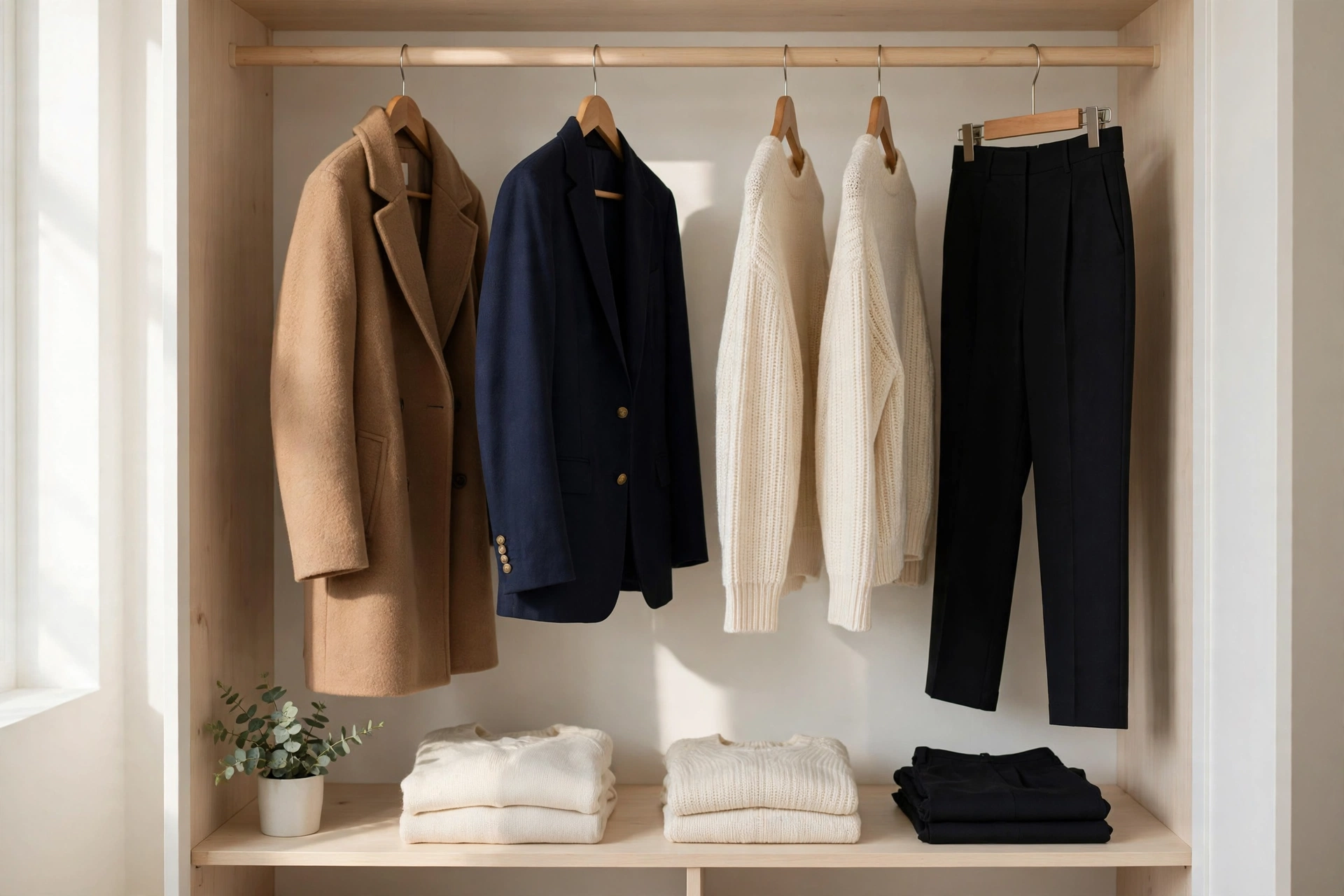
This is the easiest formula in the guide, and it works for work, for the school run and for a day out. Take a pair of straight leg trousers in black, navy or charcoal. Add a plain knit jumper in a colour that suits you, and finish with a smart wool coat. Tuck the front of the knit in lightly, and add a belt if the trousers have belt loops. Our guide to how to wear wide leg trousers covers the same idea for a wider leg, if your trousers are wide rather than straight.
Keep the colours simple. One dark colour on the bottom and one lighter colour on top is enough. Add a scarf in a colour you like, and wear shoes you can walk in, such as loafers or clean plain trainers.
Formula 2: A midi skirt, a fitted top and boots
A midi skirt looks polished without trying, because the length does the work for you. Pair it with a fitted top, such as a fine knit or a fitted shirt, and tuck the top in so your waist shows. Add knee high boots or ankle boots, and a long coat if it is cold. The fitted top matters here: a loose top over a midi skirt hides your shape and makes the outfit look shapeless.
Choose a skirt in a plain colour or a simple print, such as a small check or a dark floral. Avoid a skirt that needs constant adjusting, because an outfit you keep pulling at never looks put together.
Formula 3: Dark jeans, a blazer and a white top
Dark jeans with a blazer is the fastest way to look smart without dressing up. The jeans must be dark, clean and free of rips, because light or ripped jeans read as casual, however smart the blazer is. Add a plain white top, a black or navy blazer, and a pair of loafers or smart trainers. Roll the blazer sleeves to the forearm if the blazer is long, and keep the top tucked in.
This formula works because the blazer adds structure. A blazer with shoulder seams that sit on your shoulders makes any outfit look tailored. If your blazer is too big, wear a belt over it at the waist, or take it to a tailor for a simple adjustment.
Formula 4: A simple dress, tights and a long coat
A simple dress is a whole outfit in one piece, which is why it is the easiest formula of all. Choose a plain dress in a dark colour, add opaque tights and a long coat, and you are dressed. The dress should sit on your shoulders properly and end at the knee or just below it. If it is too long, have it shortened. A dress that fits is worth more than three dresses that do not.
Keep the rest simple. One pair of earrings, a plain bag and shoes you can walk in. Let one piece be the focus, and keep the rest quiet. This is the formula to use when you have five minutes to get ready.
Formula 5: Tailored trousers, a shirt and loafers
Tailored trousers with a shirt looks smart for work and for any daytime event. The trousers should sit at your waist and break just above your shoe. The shirt should be tucked in fully, with the collar sitting flat. Add loafers and a simple belt, and a fine knit over the shirt if it is cold.
Iron the shirt. A creased shirt ruins this formula completely, because the whole look depends on clean lines. If you do not like ironing, hang the shirt in the bathroom while you shower, and the steam will lift most of the creases.
The charity-shop hit list
Charity shops are the best place to look put together on a budget, because the pieces that last are the ones that end up there. Good wool coats, leather bags, silk scarves and quality knitwear all turn up in charity shops, often barely worn. The trick is to know what to look for and what to walk past.
Buy coats, blazers, knitwear, leather bags, silk scarves and denim. These are the pieces where quality shows, and they are the pieces people give away when they change size or clear a wardrobe. Check the seams, the lining and the buttons before you buy. A coat with a torn lining is not a bargain.
Skip shoes, swimwear and anything with a stain you cannot identify. Shoes mould to the last owner’s feet, so they rarely fit well. Avoid anything that smells of damp, because that smell does not wash out easily. And do not buy something just because it is cheap. A two pound top you will never wear is not a bargain, it is clutter.
Visit charity shops in wealthier areas if you can, and go on weekday mornings, when new stock is put out. Try everything on in the shop, because most charity shops do not offer refunds. Keep a list of your real gaps in your phone, so you buy what you need and not what catches your eye.
Fit tricks that cost nothing
Fit is free, and it is the single biggest difference between looking put together and looking untidy. A half tuck is the easiest trick: tuck just the front of your top into your trousers or skirt, and leave the back loose. It shows your waist and makes the outfit look intentional.
Roll your sleeves to the forearm. It shows your wrists, it makes a jumper or a shirt look relaxed rather than sloppy, and it stops long sleeves bunching under a coat. If your sleeves are too long, push them up and fold the cuff once. Do the same with trousers that are slightly too long: a single turn up at the hem looks deliberate, while trousers dragging on the floor look careless.
Steam or iron your clothes. Creases are the fastest way to undo a good outfit. If you do not own a steamer, hang the garment in the bathroom while you shower, or press it with a warm iron for two minutes. A smooth fabric looks expensive, and a creased fabric looks like you got dressed in the dark.
Wear a belt. A belt at the waist pulls an outfit together, and it turns a loose dress or a long shirt into a shaped outfit. Choose a plain leather belt in black or tan, and make sure it fits. A belt that is too long, with the end flapping, looks worse than no belt at all.
Grooming tricks that cost nothing
Grooming is the cheapest part of looking put together, because most of it is free. Clean hair is the first thing people notice. Wash it properly, brush it through, and tie it back neatly if you do not have time to style it. A low ponytail or a simple bun looks tidy and takes a minute.
Keep your nails short and clean. You do not need polish. A nail file and a hand cream are enough. Trim your nails once a week, push back your cuticles gently, and moisturise your hands. Chipped polish looks worse than bare nails, so if you wear polish, remove it properly when it starts to chip instead of leaving it.
Moisturise your skin and wear a lip balm. Dry skin and cracked lips make you look tired, and both are fixed in seconds. Drink water through the day, and keep a hand cream and a lip balm in your bag. These are small habits, but they show. People notice tidy hands and healthy skin before they notice a label.
Clean your shoes. Dirty shoes ruin an outfit faster than anything else, because they are the first thing people see when you walk in. Wipe leather shoes with a damp cloth, and brush suede shoes with a suede brush. It takes two minutes.
What to spend on and what to save on
Spend on the pieces you wear every day and the pieces other people see first. A good coat, everyday shoes and a pair of trousers that fit are worth real money, because their cost per wear is low and they shape every outfit you wear with them. Spend on a bag you carry daily, because a good bag lasts for years.
Save on trend pieces, tops and anything you will wear a few times. A trend colour, a statement sleeve or a party top does not need to be expensive, because you will not wear it often enough to justify the price. Buy these from the high street or second hand, and keep the money for the pieces that work hard.
Never buy something because it is on sale. A sale price is only a bargain if you would have bought it at full price and you will wear it thirty times.
| Piece | Spend or save | Why |
|---|---|---|
| Winter coat | Spend | Worn daily for months, low cost per wear |
| Everyday shoes | Spend | Comfort and quality show immediately |
| Tailored trousers | Spend | Fit shapes every outfit |
| Daily bag | Spend | Used every day, lasts for years |
| Trend tops | Save | Worn a few times, quickly out of fashion |
| Party dresses | Save | Rarely worn, high cost per wear |
| Statement jewellery | Save | High street and second hand are fine |
| Basic tights and socks | Save | Wear out fast, replace often |
Mistakes to avoid
- Buying more instead of fixing what you own: a missing button or a loose hem is a ten minute repair. Fix it before you buy a replacement.
- Chasing every trend: one trend piece per outfit is enough. Two or more looks like a costume, and it dates quickly.
- Wearing clothes that do not fit: too big looks careless, too tight looks uncomfortable. Fit matters more than the label or the price.
- Ignoring your shoes: dirty or scuffed shoes undo a good outfit. Clean them before you leave the house.
- Leaving chipped nail polish on: bare nails look better than chipped polish. Remove it properly when it starts to chip.
- Buying on sale without a plan: a bargain you never wear is not a bargain. Only buy what is on your gaps list.
- Wearing too many patterns at once: one pattern per outfit is enough. Let one piece be the focus and keep the rest plain.
- Skipping the mirror check: check the back of your outfit in a full length mirror. A crease, a tag or a stain you cannot see will be the first thing other people notice.
Frequently asked questions
How can I look put together on a very small budget?
Start with fit and grooming, because both are free. Tuck your top in, roll your sleeves, iron your clothes and clean your shoes. Then use one outfit formula from this guide with pieces you already own. Only spend money on a real gap, such as a coat or shoes, and use the cost-per-wear rule before you buy anything.
What is the cheapest way to look expensive?
Wear one colour from head to toe, or two colours at most. A single colour outfit looks intentional and expensive, whatever it cost. Keep your clothes clean and pressed, your hair tidy and your shoes clean. A plain outfit in good condition looks more expensive than a busy outfit with a designer label.
How many clothes do I need to look put together?
Far fewer than you think. A small wardrobe of pieces that fit and work together is better than a full wardrobe of random items. Ten to fifteen pieces that mix and match will give you more outfits than fifty pieces that do not go together. Our capsule wardrobe by season guide shows how a small wardrobe works through the year.
Can charity-shop clothes really look put together?
Yes, if you choose well. Look for coats, blazers, knitwear and leather bags in good condition, and check the seams, lining and buttons before you buy. Avoid shoes and anything with a stain or a damp smell. Try everything on in the shop, and only buy what is on your gaps list.
Does looking put together take a long time every morning?
No. Once you have an outfit formula and a few outfits photographed, getting dressed takes five minutes. The time goes into the one-off wardrobe sort and the habit of checking your fit in the mirror, not into every morning. A formula removes the decision, which is what makes mornings slow.
What is the one thing that makes the biggest difference?
Fit. Clothes that fit your shoulders, waist and length look expensive at any price. After fit, grooming matters most: clean hair, tidy nails and clean shoes. Those two things cost nothing, and they change how every outfit looks.
Conclusion
Looking put together on a budget is not about buying more. It is about fit, grooming and a simple outfit formula, repeated with pieces you already own. Sort your wardrobe, fix what can be repaired, and write down your real gaps. Use the cost-per-wear rule before you buy anything, and spend on the pieces you wear every day. With clean shoes, tidy hair and clothes that fit, you will look put together every day, without spending more than you already have.